Leander Elite Concrete works as a concrete contractor in Barton Creek, TX, and a good deal of the concrete here was never residential flatwork. A resort, a country club and a private school sit inside the place boundary, and between them they account for paved acreage of a kind that most communities this size never carry.
That changes what the work is. Cart paths, service yards, terraces, back-of-house circulation and long stretches of private drive are ordinary jobs here, alongside the driveways and patios you would expect. Each of those is a different product with different loads, different traffic and different tolerances.
It also changes the permitting picture in a way that surprises people. On the private streets that serve much of this place there is no public right-of-way to permit, so the county driveway permit that governs work on a maintained road simply does not apply, and the standard the work is held to becomes the one written into the contract.
The Paved Acreage That Was Never Residential
A Resort, a Club and a School Inside the Boundary
The presence of a resort, a country club and a private school inside the place boundary means the concrete inventory here is weighted toward commercial and institutional work rather than toward houses. Parking, service access, pedestrian circulation and amenity terraces are all present at a scale a residential subdivision does not carry, and they are used in a different pattern.
That is worth saying because it changes who we are usually talking to and what they need. A facilities manager planning a phased replacement of a service yard has a completely different set of constraints from a homeowner adding a patio, and pretending otherwise produces a scope that fits neither. The scheduling in particular is not comparable: one is planned around trading hours and guest movement, the other around a family’s weekend.
Multifamily Alongside Detached Housing
The residential stock is mixed as well, with 277 units in buildings of 50 or more. That puts shared walks, parking, drive aisles and accessible routes into the picture beside single-family drives and patios. Shared-property concrete has its own rhythm.
It is phased around people who live there every day, it is approved by a board or a manager rather than an owner, and its replacement is planned against a budget cycle rather than decided in an afternoon. We scope it as a written specification broken down by area, so a decision can be taken on part of it rather than all or nothing.
Amenity Work as Its Own Product
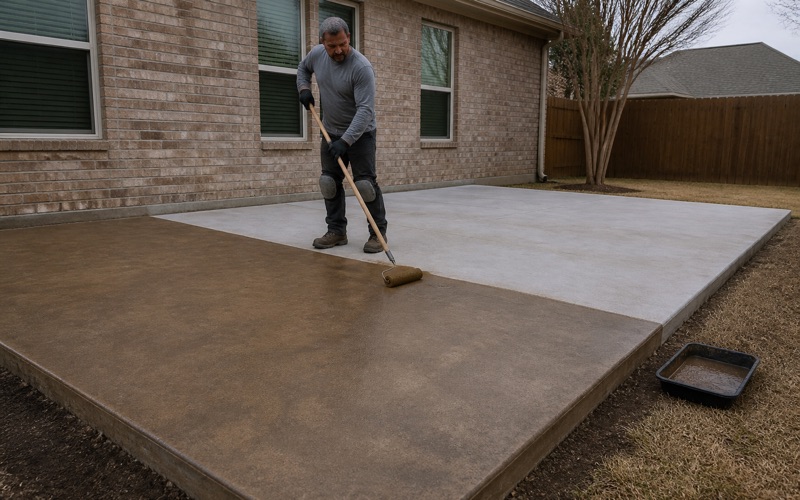
Terraces, pool surrounds, event lawn edging and the flatwork that ties amenity buildings together are specified more like commercial work than residential, because they carry concentrated pedestrian traffic and they are looked at constantly. We treat finish and jointing on that work as a design decision rather than a default. A terrace laid out with joints that fight the geometry of the space reads as an afterthought, and on a property whose whole proposition is how it looks, that matters more than it would elsewhere. Where a decorative border or a change of finish can absorb a necessary joint, we use it rather than running a bare sawcut across a sightline.
Looking for concrete-contractor closer to Jarrell? See Concrete-Contractor in Jarrell.
Private Streets, and the Permit That Does Not Exist
No Right-of-Way Means No Right-of-Way Permit
Where a street is private, there is no public right-of-way for a permit to attach to, so the county driveway permit and its inspections do not apply. Work that would be permitted and inspected on a maintained public road is simply a private contract on a private street. That is neither good nor bad on its own; it is a fact to plan around.
It removes a schedule gate and a review, and it removes the external check on standards that those things provide. For a client the practical effect is that diligence moves from the permitting process into the choice of contractor and the wording of the contract.
The County’s Position on Unmaintained Roads
The county’s position reinforces the point: it does not issue permits for driveways connecting to unmaintained or unaccepted roads. So the question of whether a permit exists is settled by the road’s status rather than by the nature of the work. We establish road status before quoting rather than assuming from the address or the street name.
It determines both what applies and who has to approve the finished work, and it is not always what a client expects. A street that is maintained by an association rather than by the county looks identical from a vehicle and is a different transaction entirely.
What Replaces the Public Standard
Where no public authority sets a floor, the specification in the contract is the only specification the work has. Thickness, base preparation, reinforcing, jointing, finish and cure are commitments made in writing or they are not commitments at all. We write them into every proposal on private-street work and record the base, the steel and the placement as the job proceeds.
That record is what a client has instead of an inspection report, and it is also what makes two prices genuinely comparable. On private-street work in particular, the gap between a well-built slab and a poorly built one is invisible on the day it is finished and obvious several years later.
Cart Paths, Service Yards and Terraces
Cart Paths as a Distinct Kind of Flatwork
A cart path is narrow, long, lightly loaded and continuously trafficked, which makes it unlike either a sidewalk or a driveway. Its failures are edge breakup, settlement at transitions and surface wear rather than structural cracking under load. We build them with attention to edges and to drainage crossings, because those are where they go first.
A path that sheds water properly and has sound, supported edges will outlast one poured thicker but detailed carelessly. Crossings are the other weak point, since a path that dips through a drainage line takes concentrated flow at exactly the place its edges are least supported.
Service Yards and Back-of-House Areas
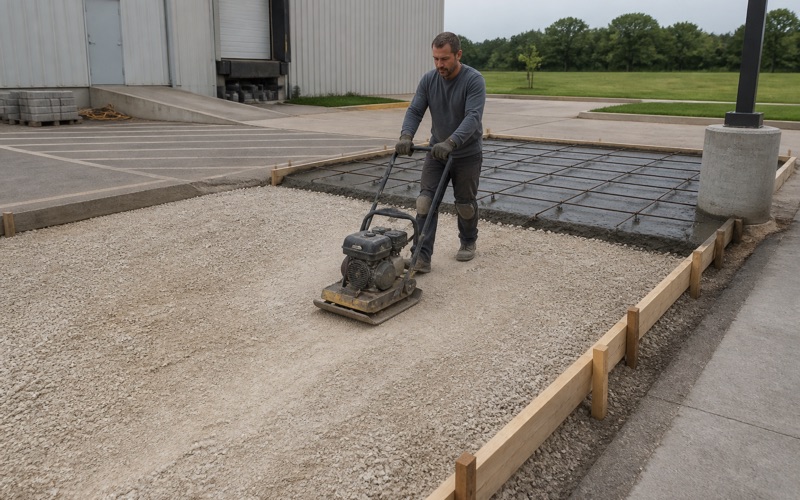
Service yards take the heaviest and least forgiving traffic on a property: delivery vehicles, waste collection, equipment on hard wheels and containers dragged across the surface. They are also the areas least likely to have been built for that when the property was first developed. We build service areas to the load rather than to the appearance of the surrounding paving, with heavier section and reinforcing where vehicles turn and stand.
A yard poured to match the visitor parking beside it fails first at exactly the points it is needed most. Replacing it then costs more than the heavier section would have, and it interrupts deliveries and collections while the work runs.
Terraces and Pedestrian Surfaces
Amenity terraces carry people rather than vehicles, but they are inspected by eye every day, so surface quality, joint layout, fall and slip resistance all carry more weight than structural capacity. We choose texture for wet grip rather than for photographs and set falls that move water off the surface without ponding at thresholds. A terrace that drains toward a doorway is a maintenance problem forever, and it is set in the first hour of forming. Where a terrace abuts a building, we also isolate the two so the slab can move without transferring that movement into the structure.
Accessible Routes Where the Residents Are Older
Age and What It Asks of a Surface
The median resident age here is 59.0 years, and that has practical consequences for flatwork. Grip when wet, consistent riser heights, generous landings and the absence of small level changes all matter more in a community whose residents are, on average, older. We design to that rather than to a minimum. A quarter-inch lip at a threshold is a nuisance for some people and a genuine hazard for others, and it costs nothing to avoid at the forming stage.
Routes Between Buildings and Parking
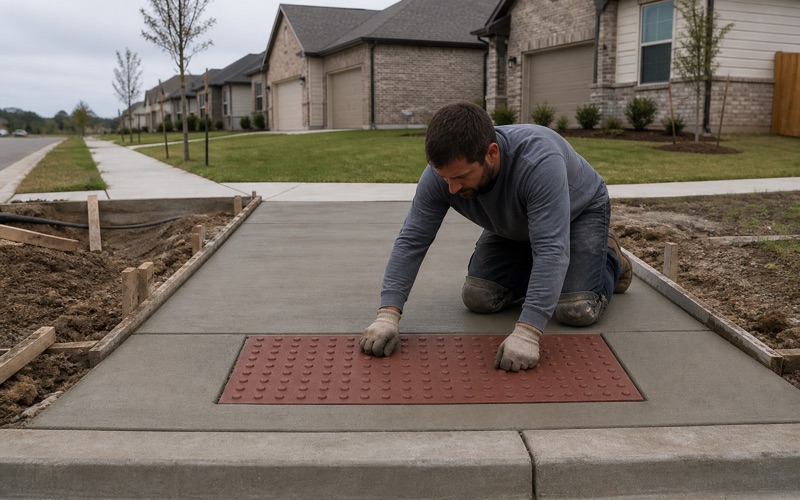
On a property with shared parking and multiple buildings, the route between them is the piece of concrete most people actually use, and it is frequently the piece least designed. Running slope, cross slope, landings and a detectable transition where a route crosses a vehicle area all belong in that design. We survey those routes with instruments rather than judging them, and we measure the whole run to identify which sections are genuinely out of tolerance rather than replacing lengths that include sound panels.
Ground That Is Not One Thing
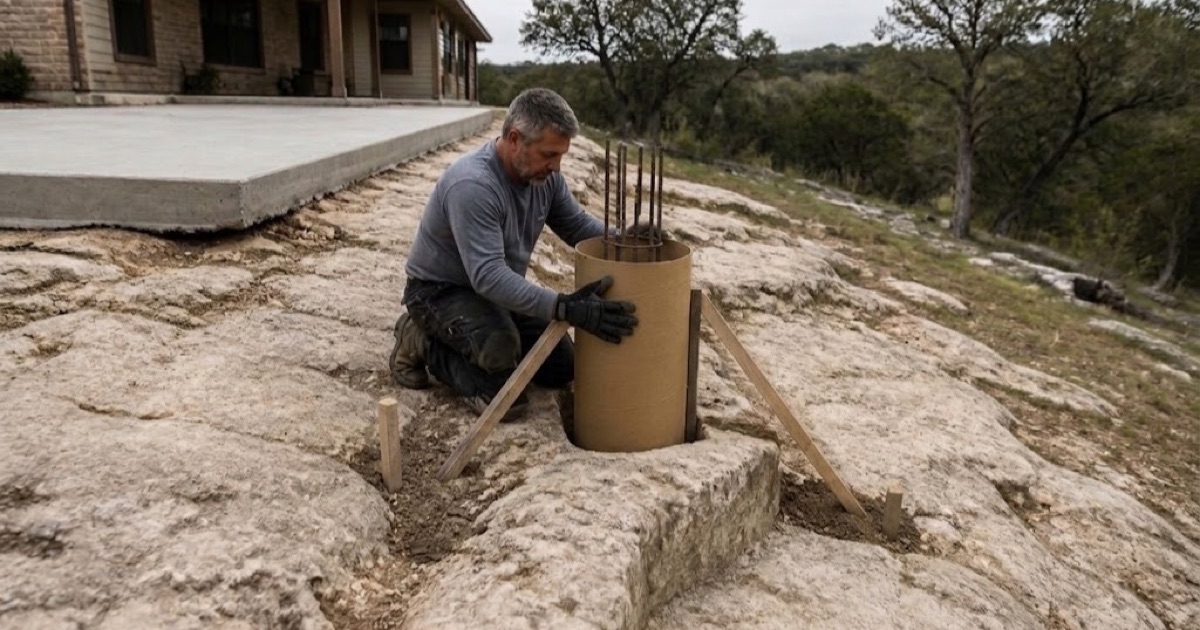
Barton Creek is a census designated place in Travis County whose population was 3,356 at the 2020 census, and the ground under it changes character across the place. The center maps as a Brackett-dominated complex that is 68 percent Brackett and 20 percent bare rock outcrop, so one acre in five in that unit is rock at the surface.
The west side is the opposite condition: Volente silty clay loam, 75 percent Volente, whose profile runs to 150 centimeters with no bedrock restriction recorded at all, and which carries a representative plasticity index of 24 to 29 against Brackett’s 17 to 18. A joint layout and a base specification that suit one are wrong for the other, and both are inside the same place.
- 20+ Years in Concrete
- Licensed & Insured
- Free Estimates