Leander Elite Concrete works as a concrete contractor in Burnet, TX, building driveways, sidewalks, patios, slabs and approaches with more than 20 years of experience behind the work. There is a single deletion in this city’s adopted code that changes what most residential concrete work requires, and it is easy to miss because it is an absence rather than an addition.
The model code exempts sidewalks and driveways from needing a permit. Burnet struck that item out of the exempt list. So flatwork here needs a permit that the model code would have waived, and a contractor working from the model text rather than from the local amendments will get that wrong.
The city then added something back in its place, exempting sheds up to 200 square feet. Those two changes together are a deliberate reshaping of what the exempt list covers, and they were adopted alongside a wholesale move to the 2021 editions.
One Line Deleted From the Exempt List
What Item Five Used to Do
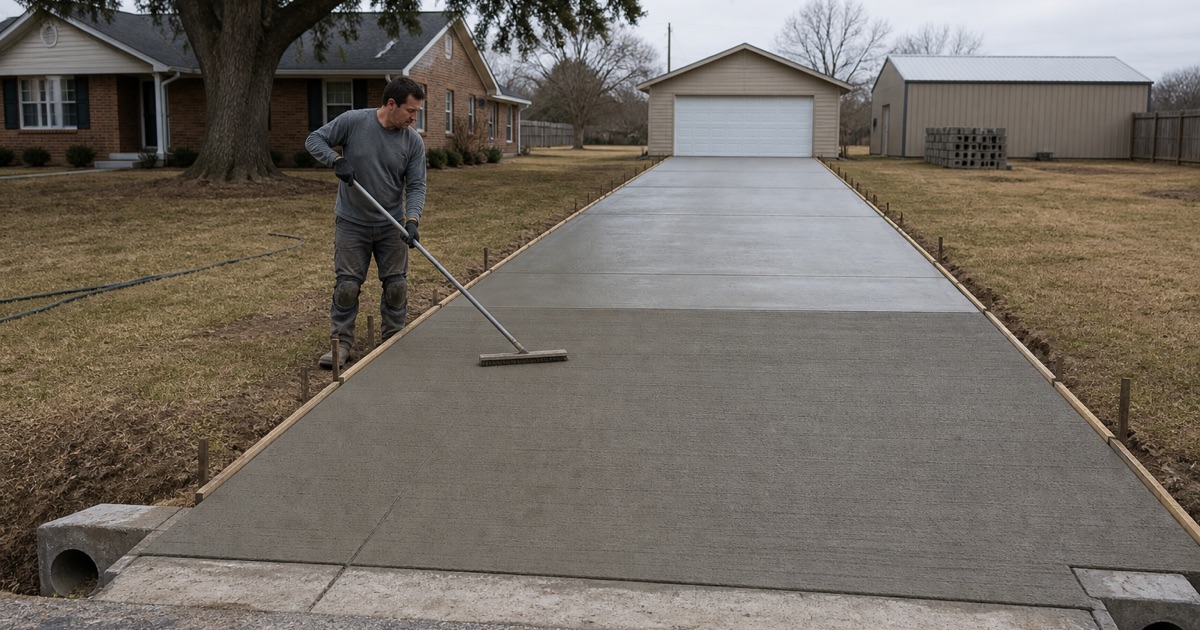
Item 5 of the model exempt list covers sidewalks and driveways, and its ordinary effect is that a homeowner can replace a walk or a drive without a permit. Removing it reverses that outcome entirely, so the work becomes permitted work.
We treat flatwork here as permitted work from the outset rather than checking whether a particular job is small enough to slip under a threshold. The deletion does not carve out an exception for size, so a modest walk replacement sits in the same category as a full driveway. Being wrong about that in the client’s favor is not a service to them either, because the exposure sits with the property rather than with whoever gave the advice.
Why the Deletion Is Easy to Miss
Most people, including many contractors, work from the familiar shape of the model exempt list rather than from a jurisdiction’s adopted amendments. A deleted item leaves no trace in the reader’s memory of the list, so the exemption feels like it is still there.
We read the adopted ordinance rather than the model text for exactly this reason. A deletion is the hardest kind of amendment to notice and the easiest to fall foul of, because nothing in the ordinary process prompts you to look for something that is not there. It is also the amendment least likely to be corrected by experience, since a contractor who has done unpermitted flatwork here without consequence will reasonably conclude the exemption stands.
What Permitted Work Changes in Practice
Once flatwork is permitted work, it acquires a timeline, a submittal and an inspection point, and those have to be built into the program rather than added to it. A job planned as though no permit were needed is a job that either waits or proceeds without one.
We plan for that from the estimate and tell the client what the sequence looks like. It is a modest amount of additional process and it is entirely manageable when it is expected, which is the whole argument for establishing it before the work is scheduled rather than after. What makes it painful is discovering it when a crew is already booked and a client is already expecting concrete on a particular day.
Looking for concrete-contractor closer to Taylor? See Concrete-Contractor Services in Taylor.
What the City Added Back in Its Place
The Shed Exemption
The city added a new item 10 exempting sheds up to 200 square feet. That is a genuine exemption rather than a formality, and it covers a size of structure that a great many properties want. For concrete work it matters because a shed pad and the shed on it are separate questions.
We are clear about which parts of a project sit inside the exemption and which do not, since a client hearing that a shed is exempt reasonably assumes everything associated with it is. That assumption is understandable and it is not what the amendments say, so we set out the two questions separately at the estimate rather than letting them run together.
Reading the Two Changes Together
Taken together, the deletion and the addition describe a jurisdiction that has thought about which work it wants to see and which it does not. Flatwork in and near the right-of-way is in; a small accessory structure is out. That is a coherent position rather than an arbitrary one, and it is worth understanding rather than merely complying with.
Knowing why a rule exists usually makes it easier to plan a project around it and to explain the plan to a client. It also makes it easier to predict how a marginal case will be treated, which is more useful than any amount of guessing from the text alone.
The Ground the Rules Sit On
Burnet sits on the eastern flank of the Llano Uplift, and the ground records that as a boundary rather than as a single rock type. Clipped to the city polygon, 84.0 percent of the named soil components formed in limestone, chalk or marl, 5.7 percent in sandstone and 3.3 percent in granite or gneiss.
The granitic soils are real, they are on the west side, and they behave nothing like the limestone soils beside them: Click runs 7 percent clay at a plasticity index of 3 with very fast drainage, while the dominant Eckrant-Rock outcrop association covering 26.86 percent of the city puts indurated limestone at a representative 28 centimeters. A base specification written for one side of town is the wrong specification on the other.
Working Under the 2021 Editions
A Decade of the 2015s, Then a Change
The 2021 editions were adopted on February 11, 2025, by Ordinance No. 2025-07, replacing the 2015 editions the city had been working under. That is a substantial jump rather than an incremental update, and it changed a great deal at once.
We work from the current adopted editions and check the local amendments against them rather than assuming continuity with what applied before. A jurisdiction that has just moved forward six years is one where habits formed under the previous text are most likely to be wrong.
Where a Version Change Bites
Code changes rarely affect the concrete itself and frequently affect everything around it: what needs a permit, what needs an inspection, how a submittal is made and which references a detail points at. Those are exactly the areas where a contractor’s routine is hardest to update.
We confirm requirements against the adopted text on each job rather than relying on what applied to the last one. In the period after an adoption that is not excessive caution; it is the only reliable approach. It also protects the client from inheriting a defect that surfaces years later at a sale, when the cost of correcting it is at its highest and the original crew is long gone.
Transitional Projects
Work that straddles an adoption date raises the question of which text governs, and the answer usually follows when the permit was issued rather than when the concrete is placed. That is worth establishing rather than assuming. We ask the question rather than guessing, because the consequence of building to superseded requirements is not academic. It is the kind of detail that costs nothing to check and a great deal to get wrong.
Cutting the Street, and the Bond That Comes With It
Excavating in the Street as an Offense
Excavating in the street without a permit is an offense here rather than a matter for a notice, which is stronger language than most jurisdictions use. That framing tells you how seriously the city treats its own pavement. We do not begin work in the street without the permit in hand.
There is no version of that job worth doing on the assumption that a permit will follow, and the ordinance leaves no ambiguity about the position. Where a schedule genuinely cannot accommodate the lead time, the right answer is to move the schedule rather than to start and apply afterward.
The Right-of-Way Bond
The ordinance writes a bond floor into the right-of-way requirements, so fiscal security is part of the permit rather than an occasional condition attached to larger jobs. That is a cost and an administrative step that belongs in the price from the beginning. We carry the required security and include it in what we quote rather than presenting it later as an additional item.
A price that omits it is not a lower price; it is an incomplete one. Clients comparing bids on street work here are well served by asking directly whether the security is included, because it is one of the easiest items for a low number to have left out.
Restoring What Was Cut
Beyond the bond, the practical obligation is to leave the street as good as it was found. Burnet is the county seat of Burnet County with a population of 6,436 at the 2020 census, and on streets of that scale a poorly restored cut is visible to everyone who uses them. We saw to clean edges, reinstate base to a proper compaction and restore the surface to match rather than patching to a lower standard.
A cut restored properly disappears; one restored carelessly becomes a defect the city and the neighbors both remember. It also tends to fail again along the same line within a few seasons, which turns a single restoration into a recurring obligation on whoever owns the property.
- 20+ Years in Concrete
- Licensed & Insured
- Free Estimates