Leander Elite Concrete builds concrete pool deck surfaces in Leander, TX and nearby cities including Lakeway, Steiner Ranch, Bee Cave, Lost Creek and Cedar Park, with more than 20 years of flatwork experience in Central Texas conditions. A pool deck is the hardest working piece of decorative concrete on a property: it is wet, it is walked on barefoot, it takes full sun through the hottest part of the year, and it is the surface people look at while they are in the water.
Those demands pull against each other, which is why a pool deck is a specification problem rather than a style choice. Aggressive texture grips well when wet and abrades feet; a smooth trowel finish is comfortable and dangerously slick; dark color looks excellent in photographs and becomes untouchable in August. We resolve those trade-offs deliberately with you rather than defaulting to whatever the last deck used.
Finish, Texture and Comfort Underfoot
Salt Finish and Light Broom Textures
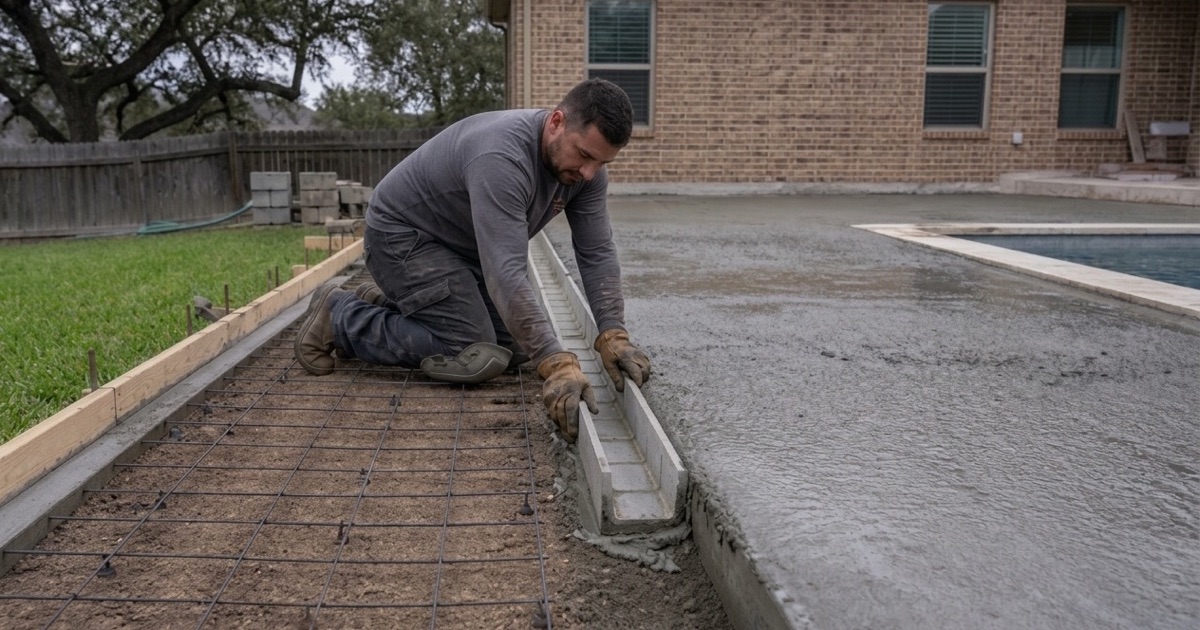
A salt finish gives a fine, open texture that drains and grips without the coarseness of a heavy broom, and a light broom finish delivers similar performance at lower cost with a more utilitarian look. Both suit the wet, barefoot conditions around a pool far better than a hard trowel finish. We sample the texture on site so you can feel it rather than choosing from a photograph.
Color, Heat and Barefoot Tolerance
Surface temperature in full Texas sun is a functional property of a pool deck, not an aesthetic footnote, and lighter colors run meaningfully cooler than dark ones. We show weathered samples so the choice accounts for how the color will look after a few summers as well as how hot it will be. Integral color also holds up far better than a surface treatment in constant sun and pool chemistry.
Slip Resistance and Sealer Choice
Sealer changes slip resistance at least as much as the finish does, so we treat the two as one decision. A penetrating sealer alters appearance and grip very little, while a film-forming sealer adds gloss and needs a slip-resistant additive to be safe around water. We would rather deliver a deck that stays safe wet than one that photographs well and is treacherous the first time it rains.
Layout, Drainage and the Pool Itself
Deck Width, Circulation and Furniture
We lay the deck out around how the space is used: a clear walking route past furniture, depth for loungers plus circulation behind them, and access to equipment that does not cross the wet area. That usually calls for more deck than the minimum that will fit around the shell. Marking the outline before forming lets you walk the layout while it can still be changed cheaply.
Fall, Drains and Where Splash-Out Goes
A pool deck has to shed water away from the pool and away from the house, and where the surrounding grade will not accept it, we plan deck drains and their outfall before the pour rather than after. Water that ponds against a foundation on expansive clay is a far more expensive problem than the deck it started on. Fall is set with instruments and checked before concrete arrives.
Coping, Expansion Joints and the Bond Beam
The deck and the pool structure are separate things that must be allowed to move separately, so an expansion joint runs between the deck and the coping and is filled with a material that stays flexible rather than grouted solid. We detail that joint properly and maintain it. A deck locked hard against a bond beam transfers movement straight into whichever element is weaker.
Replacing or Resurfacing an Existing Deck
Removal Without Damaging the Pool
Replacement work is won or lost during demolition, so we break concrete working away from the shell, protect the tile line and coping, and keep equipment loads off the bond beam. Where the existing coping is sound and worth keeping, it comes off carefully before the deck rather than being levered out with it. That care is the difference between a new deck and a new deck plus pool repairs.
Overlays, Microtoppings and When They Work
Where the existing slab is structurally sound, level and free of an old film-forming sealer, a bonded overlay or a microtopping can give a new surface and a new texture without full replacement. Where the slab is settling, spalling or cracking through, an overlay simply passes those defects upward on a delay. We test and inspect before recommending one, because the honest answer is often replacement.
Cracks, Settlement and Deck Repair
Settled Deck Panels and Voids Beneath Them
Pool decks settle more often than other flatwork because water is delivered to the same ground every day, from splash-out, backwash and irrigation, and it washes support out from under the edges. We probe for the void, fill it and lift the panel back to a grade that drains rather than simply raising the visible half of the problem. A deck lifted over an active washout drops again on the same schedule.
Cracks at the Coping and Around Skimmers
Cracks concentrating at the coping line or radiating from a skimmer usually indicate movement between the deck and the pool structure rather than defective concrete, and the fix is to restore the separation between them. We rout and reseal the expansion joint with a flexible material rather than filling it hard. A deck grouted solid against the bond beam has nowhere to put its movement except into a crack.
Resurfacing Worn or Spalling Decks
An older deck that is structurally sound but worn, spalled or simply dated can often take a new textured surface without replacement, provided any old film-forming sealer is removed and the slab is not still losing its top layer. We test adhesion in a hidden area first. Resurfacing over concrete that is actively delaminating just buries the failure under something newer and more expensive.
- 20+ Years in Concrete
- Licensed & Insured
- Free Estimates