
Leander Elite Concrete handles concrete repair across Leander, TX and the surrounding cities including Cedar Park, Santa Rita Ranch, Liberty Hill, Brushy Creek and Lago Vista, with more than 20 years spent on slabs, drives, walks and commercial flatwork in this part of Central Texas. Repair here is not a single trade. It runs from crack routing on a two-year-old drive to lifting a settled walk back to grade and rebuilding an approach the city will accept.
The first job on every repair is deciding what actually failed. Concrete is a symptom reporter: the crack, the drop, the puddle and the raised edge each point at something below the surface that caused them, and the fix that ignores the cause always reappears in the same place. We investigate the subgrade, the base, the drainage and the joint layout before quoting a repair, which is why some of our estimates recommend less work than the homeowner expected and a few recommend more.
The ground here makes that diagnosis worth doing properly. Leander sits across three different excavation conditions, with shallow rock on the west and south sides, deep shrink swell clay elsewhere and a nearly inert calcareous loam in between. A slab that cracked on expansive clay failed for a completely different reason than one that cracked over limestone, and the repairs that hold on each are not interchangeable.
Residential Concrete Repair
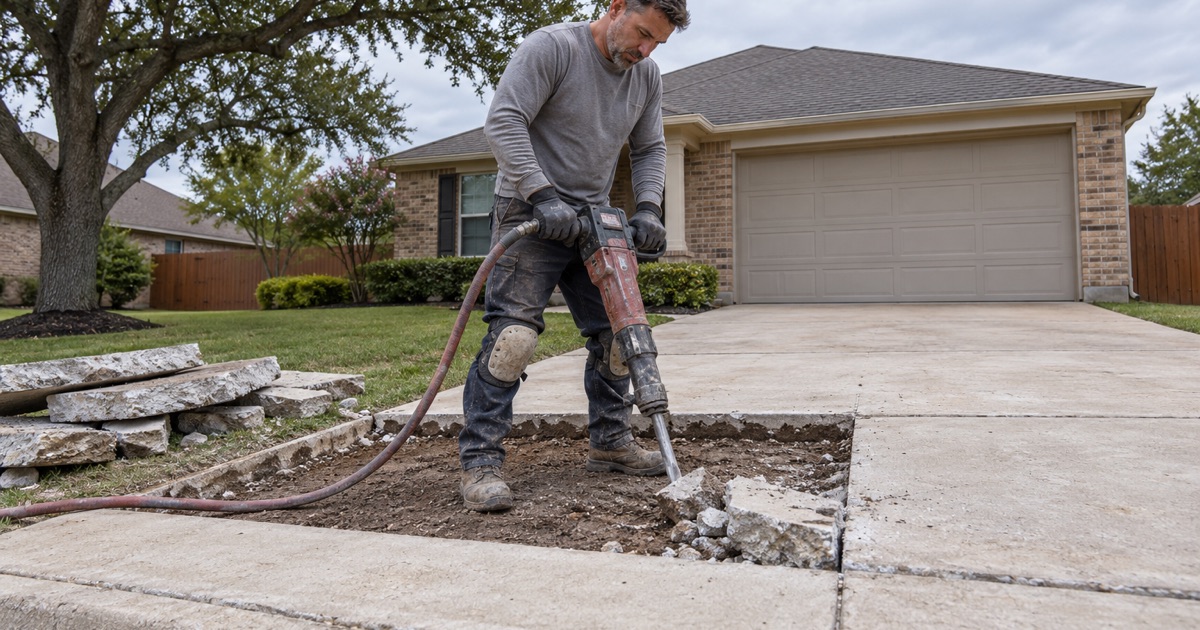
Driveway Crack Repair and Slab Replacement
A cracked driveway is worth repairing when the panels are sound, the base is intact and the cracking is confined to a few lines; it is worth replacing when the panels have broken into pieces small enough to rock underfoot. We rout and fill working cracks with a flexible sealant that tolerates the movement instead of a rigid patch that debonds through the first summer. Where the base has failed, we say so, because a filled crack over a soft subgrade reopens on the same line and the second repair costs more than the first replacement would have.
Sidewalk Trip Hazard Repair
A vertical offset in a walk is both a maintenance defect and a liability question, and the answer changes depending on whether the walk sits on private property or in the city right of way. We resolve small offsets by grinding the high edge to a compliant slope and larger ones by lifting or replacing the panel, because grinding away more than a modest lift leaves a visible dished patch that collects water. Documented remediation matters as much as the concrete itself when somebody has already fallen.
Patio, Pool Deck and Porch Surface Repair
Surface failures on a patio or pool deck are usually scaling, spalling or a delaminated trowel finish rather than structural cracking, and each has its own cause: finishing water into the surface, freeze cycles on a weak top layer, or a sealer that trapped moisture. We identify which one produced the damage before choosing between a bonded overlay, a microtopping and full replacement. Resurfacing over concrete that is still losing its top layer simply buries the problem under something newer.
Commercial Concrete Repair
Parking Lot and Drive Aisle Repair
Commercial pavement fails first at the entrance, at drive aisle turns and wherever a loaded truck tracks the same line every day, and the repair has to match the load rather than the appearance of the surrounding lot. We saw out full panels to a clean edge, reinstate the base to the specified compaction and replace with the section the traffic actually calls for, using dowel baskets across joints where load transfer matters. Patching a rutted aisle without correcting the base returns a smooth surface that ruts again on the same schedule.
Dumpster Pad and Loading Area Rebuild
Dumpster pads take a front-loading truck’s concentrated axle load plus the abrasion of a steel container dragged across the surface, so they are the first slab on a commercial property to break down and rarely worth patching once the corners have gone. We rebuild them thicker and more heavily reinforced than the surrounding lot rather than matching what was there. A replacement poured to parking-lot thickness fails at the container corners again within a few seasons.
Accessible Route and Curb Ramp Correction
A curb ramp or accessible route that has settled out of tolerance is a compliance failure as well as a concrete one, and the running slope, the cross slope and the detectable warning surface all have to come back inside range together. We survey the route with a level, rebuild the panels that are out and reset the warning surface to the correct position at the street. Larger commercial projects can also draw TDLR architectural barriers review, which we build to rather than around.
What Is Actually Failing Under a Damaged Slab
Voids, Erosion and Lost Support
Most settled slabs are not defective concrete; they are sound concrete bridging a void left by erosion, poor original compaction or expansive clay shrinking away in a dry spell. We probe and investigate before proposing a lift, because filling the void is the repair and raising the slab is only the visible half of it. A slab lifted over unresolved erosion drops again once the next wet season moves the same soil.
Joints That Were Never Cut or Were Cut Too Late
A control joint decides where a slab cracks, and a slab jointed too shallow, too far apart or too long after placement cracks wherever it likes instead. We map the existing joint pattern before repairing, and where the layout is the cause we add sawcut joints on a corrected spacing rather than only filling what has already opened. Repairing cracks on a badly jointed slab without fixing the spacing produces a new crack beside the repair.
Water Running the Wrong Way
Standing water on flatwork and runoff heading back toward a foundation are grade problems, and no sealer, patch or overlay corrects a grade. We measure fall across the surface first and fix it by lifting or replacing panels so water leaves the structure. On expansive clay this matters well beyond the concrete, because water repeatedly delivered to one side of a foundation moves far more than the slab it landed on.
Our Step-by-Step Concrete Repair Process
1. On-Site Assessment and Cause Diagnosis
We walk the concrete with you, measure offsets and fall, probe for voids and look at the joint layout, the drainage and what the surrounding ground is doing. The output is a cause, not just a list of damage. That is the step that decides whether the honest recommendation is a repair, a replacement or leaving a cosmetic crack alone.
2. Written Scope and Fixed Proposal
Every job gets a written proposal naming the method, the materials, the area and the price before anything starts. Where a permit, bond or deposit applies, it is identified in that document rather than raised later. A repair quoted as a lump sum with no method named is a repair you cannot compare against anybody else’s.
3. Removal, Void Filling and Base Correction
We saw to clean edges rather than breaking to ragged ones, remove only what has to go, then fill voids and reinstate base to a verified compaction. Where rock has to come out, it comes out mechanically with a hydraulic breaker or rock saw, since blasting is prohibited in Leander and temporary rock crushing is not permitted either.
4. Placement, Jointing and Cure
New concrete goes in at the specified thickness with steel on chairs rather than laid on the base, joints cut on a corrected spacing with an early-entry saw, and the surface cured with a membrane curing compound meeting ASTM C309. Curing is where a repair either matches the durability of the original slab or quietly falls short of it.
5. Final Walkthrough and Load Timing
We walk the finished work with you, confirm fall and offsets are where they should be, and give a specific date for foot traffic and vehicle load rather than a vague wait. Concrete is hard to the touch well before it will carry a car, and driving on a repair early is a common way to lose it.
- 20+ Years in Concrete
- Licensed & Insured
- Free Estimates