Leander Elite Concrete works as a concrete contractor in Dripping Springs, TX, building slabs, patios, walks, pads and driveways with more than 20 years of experience behind the work. Before any concrete is ordered here there is a permit that governs the ground itself, and it applies to work most people would not think of as construction at all.
City code makes it an offense for any person to grade or fill a vacant lot without first applying for and receiving a grade and fill permit from the city. That is framed as an offense rather than as a violation subject to a notice, which is unusually strong language for an earthworks requirement.
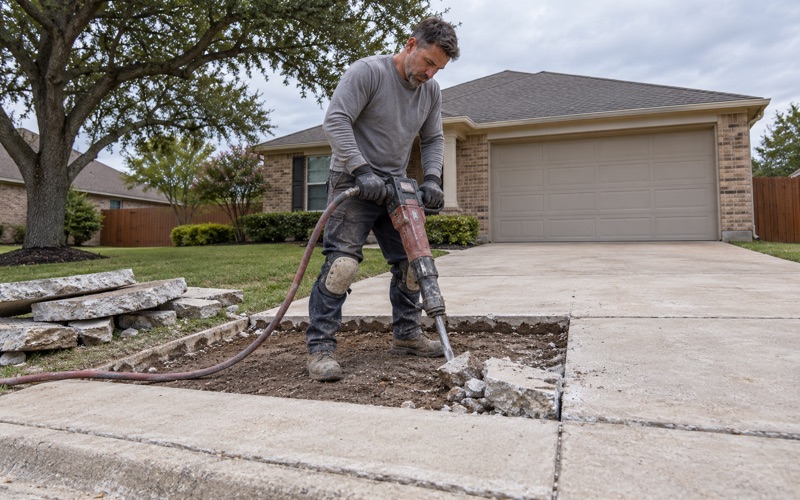
For concrete work that matters because moving dirt is the first thing that happens on most jobs. A slab, a pad or a driveway on a vacant lot begins with grading, and the permit governs that step rather than the pour that follows it.
The Permit That Comes Before Any Concrete Is Ordered
Grading and Filling as Permitted Work
The requirement attaches to grading or filling a vacant lot, and it has to be applied for and received before the work rather than regularized afterward. That places it firmly at the front of the program. We establish whether a lot falls within that requirement before scheduling anything.
It is a short question with a clear answer, and getting it wrong means starting a job with an offense rather than with a permit. That distinction is not rhetorical: an offense is a different category of problem from a procedural lapse, and it is not the position any client wants their property to be in.
Why It Catches People Out
Earthworks does not feel like permitted construction. It produces no structure, it is frequently done by a different trade from the one doing the concrete, and on many sites it is treated as site preparation rather than as work in its own right.
That framing is exactly what leads to it being overlooked. We treat the earthworks as a permitted activity in its own right, with its own approval, rather than as the beginning of the concrete job. Where a separate contractor is doing the earthworks, we confirm that the permit is in place rather than assuming it has been handled, since the requirement attaches to the work rather than to whoever happens to be doing it.
The Ground That Is Being Moved
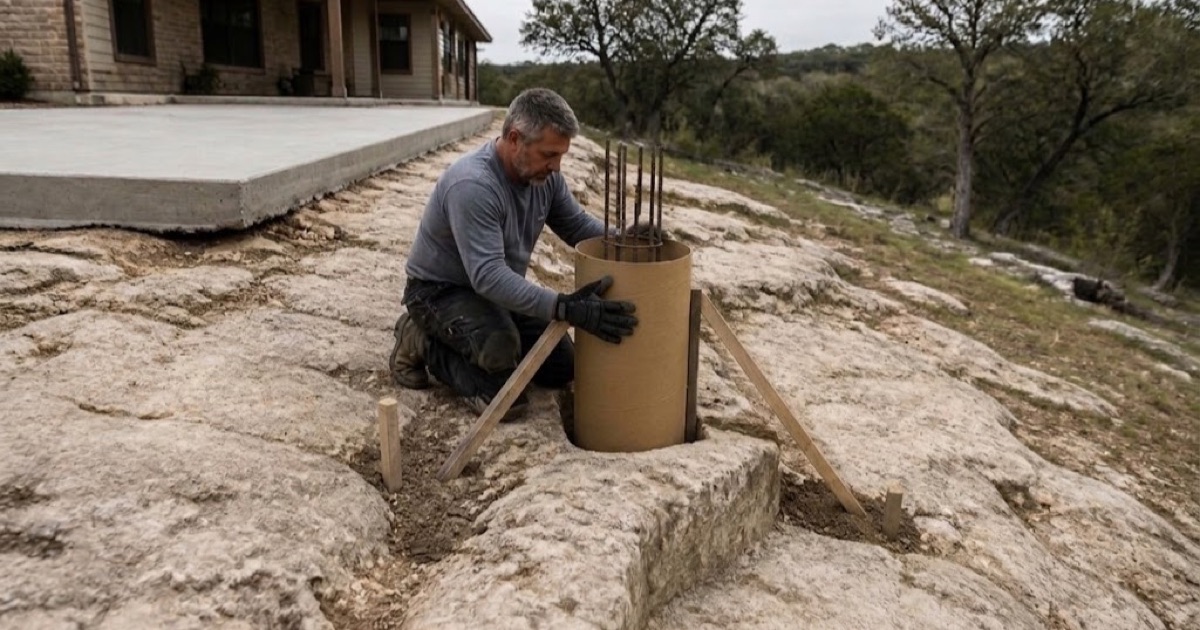
This is limestone ground with almost nothing else in it: 93.9 percent of the named soil components across the city formed in limestone, chalk or marl, and 8.8 percent of the city’s surface is mapped as bare rock outcrop. Refusal is shallow and split almost evenly between rippable and not, with 45.8 percent of named components carrying weakly or moderately coherent paralithic bedrock and 40.8 percent carrying indurated lithic bedrock. Only 8.1 percent carry no restriction at all, and whether a trench can be ripped or has to be broken can change inside a single map unit here.
Looking for concrete-contractor closer to Cedar Park? See Concrete-Contractor in Cedar Park.
Six Feet of Cut, Six Feet of Fill, and Who May Approve More
The Two Caps
The earthwork itself is capped: no fill on a site may exceed a maximum of six feet in depth, and no cut on any site may be greater than six feet. Those are separate limits and a project has to satisfy both.
On sloping Hill Country ground six feet is a real constraint rather than a theoretical one. A design that levels a fall across a site can reach it quickly, which is why we check the cut and fill volumes at the design stage rather than assuming they are within range. It is also a limit that is easier to breach with fill than with cut on a falling site, because levelling out toward a downhill boundary accumulates depth quickly.
Who Can Approve More
The exceptions are specific rather than general. Fill beyond the limit may be approved by the city engineer in designated permanent on-site spoils disposal sites, and a cut greater than six feet may be approved by the site development review committee, except for structural excavation. Those are different approvers for the two directions, which is worth knowing when a project needs relief on one and not the other.
We identify which approval a design actually requires rather than submitting to whichever body seems most likely. Submitting to the wrong one costs time rather than money, but on a project already waiting on an earthworks permit that time is the thing in shortest supply.
Designing to Stay Within the Caps
Where a design approaches the limits, the useful move is usually to work with the slope rather than against it: terracing rather than levelling, stepping a patio in two planes, or accepting a fall across a surface that drains rather than flattening it entirely. We propose those alternatives early. They frequently produce a better result than a single flat platform would have, and they keep a project inside a limit rather than dependent on an approval that may not come.
Stockpiling on a Clock
Permits Limited in Term
A permit for stockpiling dirt or other fill material may only be for a limited term. That converts material storage from an open-ended convenience into something with an expiry date attached. We plan material movement around that rather than stockpiling and dealing with it later. On a job that generates spoil, knowing in advance where it goes and by when is part of the scope rather than an afterthought.
Sequencing to Reduce Stockpiling
The most practical response to a time-limited stockpile permit is to need less stockpiling. Balancing cut and fill on site where possible, and timing removal to follow excavation closely, both reduce how much material is sitting anywhere. We sequence the work that way where the site allows it.
It saves the double handling that stockpiling always involves, and it keeps a site tidier and safer while the work runs. On a residential job that matters to the client directly, since a stockpile in a front yard is the most visible part of a project and usually the part neighbors notice first.
Spoil on a Rocky Site
On ground where a significant share of the excavation is rock, the spoil is heavier, bulkier and less useful as fill than soil would be, which makes the disposal question larger rather than smaller. We price spoil handling realistically rather than assuming material can be spread on site. Broken limestone is not topsoil and it is not a growing medium, and pretending otherwise leaves a client with a problem in their yard rather than a solution. Where broken stone can genuinely be used on site, as fill in a location that suits it or as a base under something else, we will say so, and where it cannot we price its removal properly.
Registering as a Contractor, and the State License Behind It
Contractor Registration
Contractor registration here requires a state license where one exists for the trade in question. That is a check on who may work in the city rather than on what may be built. We keep our registration current rather than dealing with it per job.
It is a small piece of administration that becomes a delay if it is left until a project is ready to start. It is also a reasonable thing for a client to ask about, and a contractor who cannot answer it quickly is telling you something.
What the State Does and Does Not License
The state licensing picture is worth understanding, because it does not cover every trade a client might assume it does. Where a state license exists for a trade, registration depends on it; where none exists, the registration requirement works differently. We are straightforward about what we hold and what applies to our trade. Dripping Springs is a city in Hays County in the Greater Austin metropolitan area whose population was 4,650 at the 2020 census, and a client here is entitled to a clear answer about credentials rather than an implied one.
Putting It All Together on a Job
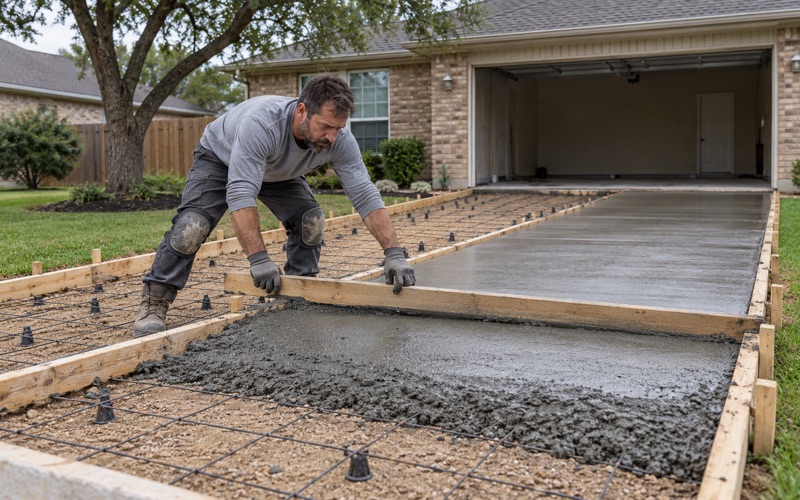
In practice a project here sequences as registration, then the grade and fill permit, then the earthworks within the cut and fill caps, then the concrete. Each step gates the next, and the concrete is genuinely the last of them. We plan jobs in that order and tell the client what the timeline looks like at the estimate. Nothing about it is difficult once it is expected, and almost all of the difficulty comes from expecting to start with a pour.
Building on Rock Once the Ground Is Settled
Once the earthworks are permitted and done, the concrete work is governed by the same ground the permits were written for. Brackett, the single most common component in the city, is a shallow soil sitting directly on weakly coherent rock at a representative 36 centimeters, about 14 inches, at 30 percent clay with a plasticity index of 17 to 18 and very low linear extensibility.
Comfort, mapped in the same units, reads the opposite way on both counts: indurated limestone at 33 centimeters and a Bt horizon at 65 percent clay with a plasticity index of 46, but a linear extensibility of only 3.2 percent. Read alone, that plasticity index describes a heaving soil; the linear extensibility says the failure to design for is bearing on rock and thin cover rather than seasonal movement, and we specify the base accordingly.
- 20+ Years in Concrete
- Licensed & Insured
- Free Estimates