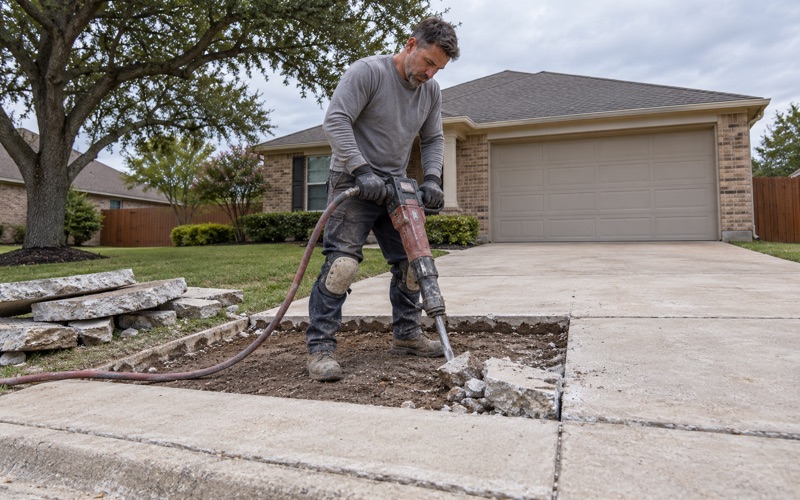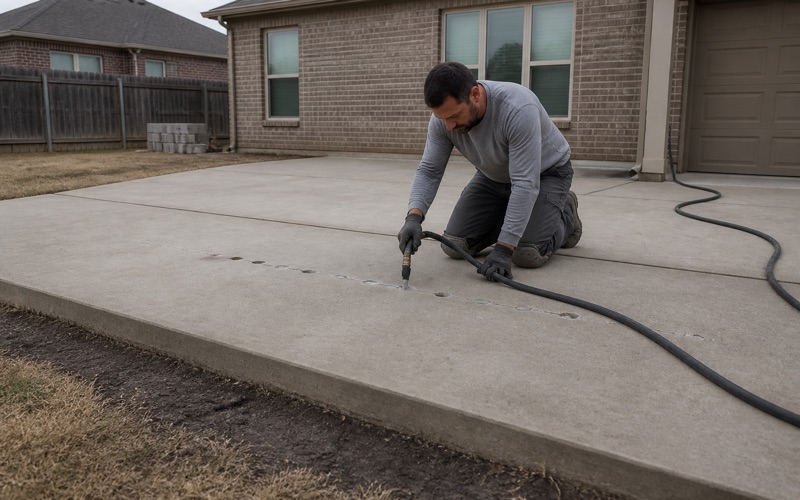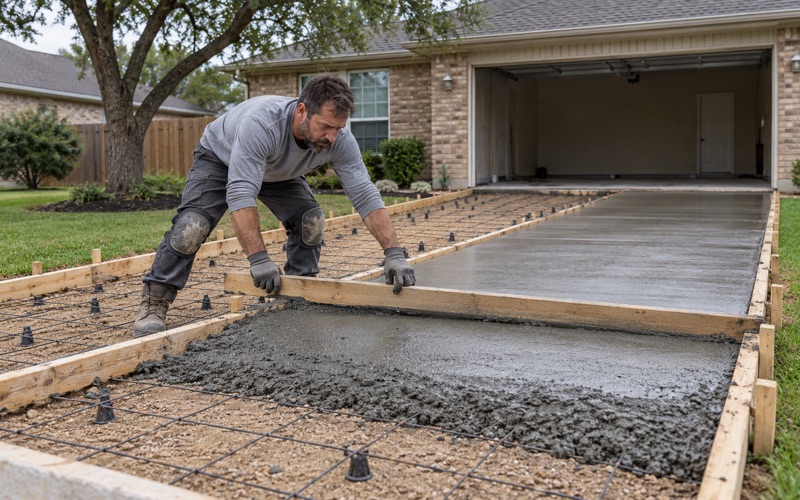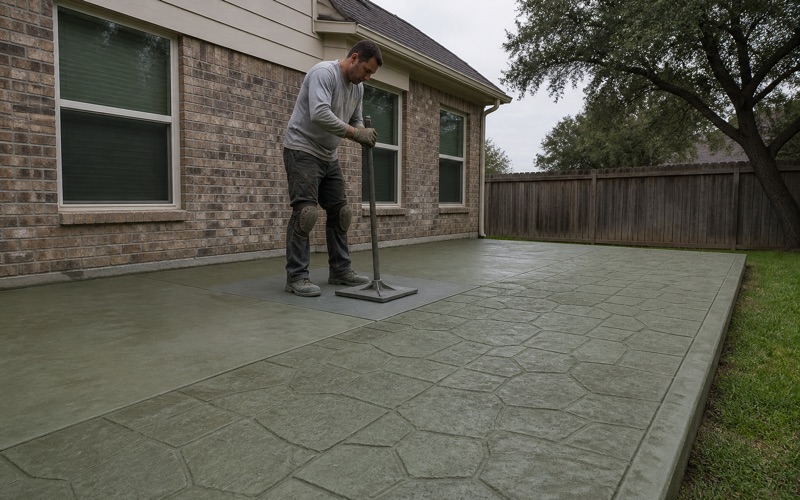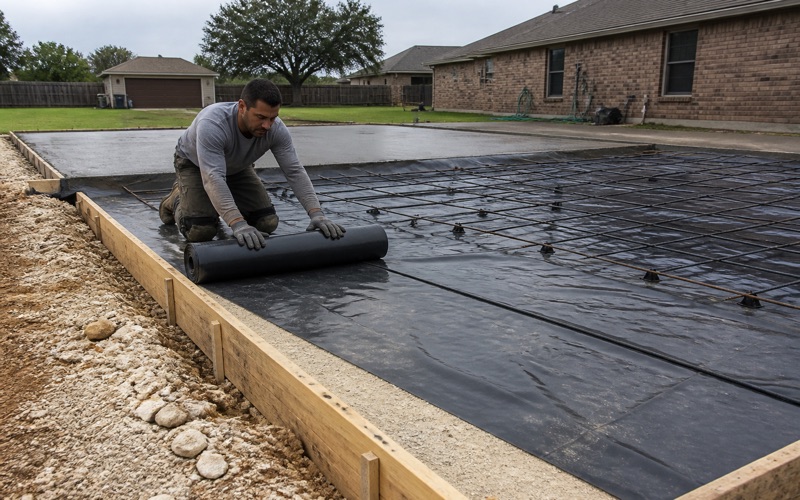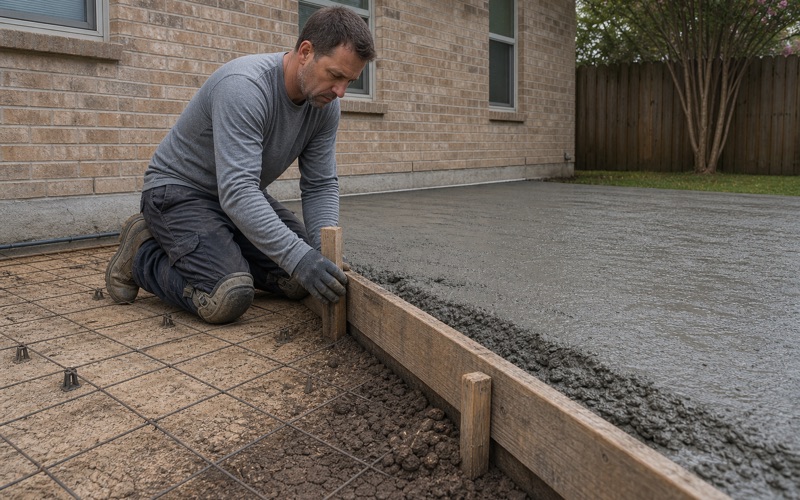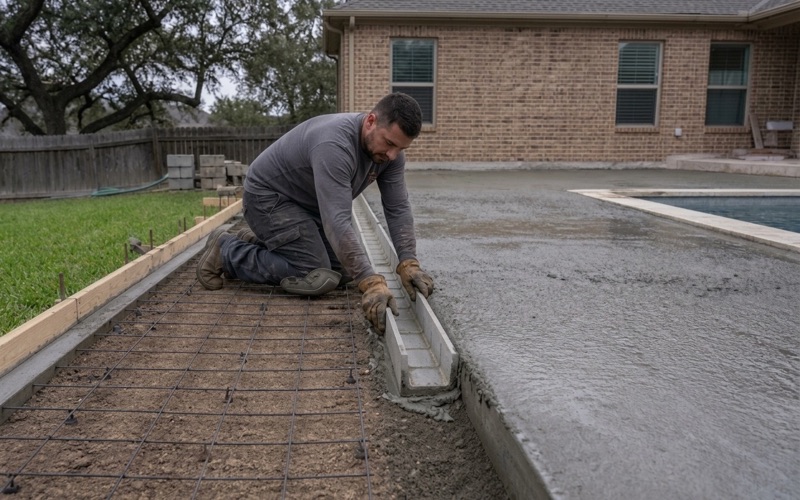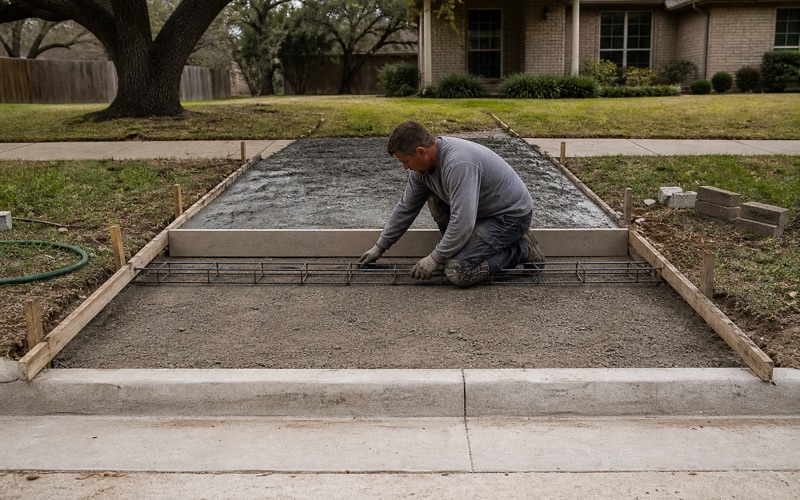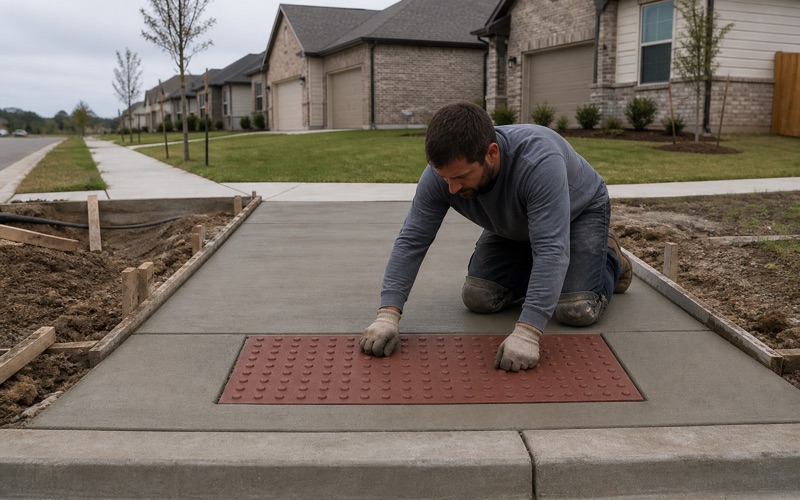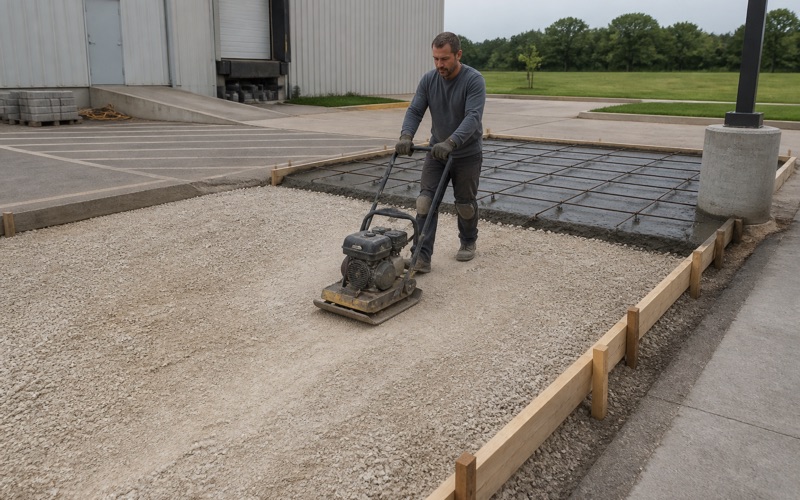
Leander Elite Concrete works as a concrete contractor in Liberty Hill, TX, building driveways, patios, slabs, walks, pool decks and commercial paving with more than 20 years of experience across this part of Williamson County. The concrete itself is the familiar part of the work. What is unusual here is that the size of the paving, measured in square feet, is what decides which permit track a project runs on.
That threshold is not a formality. It separates a job the City Engineer can review from one that goes further, and it lands squarely in the range a real commercial parking area or a large residential paving project occupies. Crossing it unintentionally is expensive in time rather than in concrete.
The other surprise on most plan sets here is whose standards they cite. Liberty Hill does not publish its own engineering standards for public facilities; it adopts another city’s outright, and it says so in the Unified Development Code. We work to those documents rather than to a generic specification, because that is what the reviewer will be reading.
Square Feet of Paving Decides Which Permit You Are On
The 7,500 Square Foot Site Development Threshold
Under UDC Section 6.03.01, paving or other impervious surface alteration of 7,500 square feet or more, or drainage modification with a drainage area of five acres or more, that does not join or abut a public right-of-way requires a site development permit. That number is measured in area rather than in construction cost, so an inexpensive but wide expanse of paving crosses it while a costly, compact job does not.
We calculate the paving area at the estimate and tell you which side of the line the project falls on before any design work happens. A parking area, a large equipment yard or an extensive residential paving scheme can sit close enough to the threshold that a modest change in layout moves it, and that is a decision worth taking deliberately rather than discovering after a submittal.
The Thousand Square Foot City Engineer Track
The same section provides that paving alteration of 1,000 square feet, or drainage modification with a catchment of five acres or less, may be reviewed and permitted by the City Engineer without City Council approval. That is a materially different route: it stays inside an engineering review rather than going to a council agenda, with the schedule implications that follow.
Knowing which track applies changes how a project should be phased and how far ahead it has to start. We plan the submittal around the applicable path from the beginning, since a job scoped as though it were on the lighter track and then found to be on the heavier one loses weeks that no amount of site productivity recovers.
The Residential Exemption That Turns on Lot Size
There is a residential carve-out, and it is written around the subdivision rather than the project: construction on single-family or duplex lots in existing subdivisions with average lot sizes greater than one-half acre, or 21,780 square feet, does not require a site development permit. The test is the average lot size in the subdivision, not the size of the specific lot or the size of the slab.
That distinction catches people out in both directions. We check the subdivision’s characteristics rather than assuming that a large individual lot carries the exemption or that a modest patio is automatically outside the requirement, because neither of those follows from the way the provision is drafted.
Looking for concrete-contractor closer to Brushy Creek? See Concrete-Contractor in Brushy Creek.
Why the Standards on Your Plan Set Say Round Rock
An Adopted Set of Another City’s Standards
UDC Section 5.02 provides that the City of Round Rock’s Design and Construction Standards shall apply for all public facilities within the city limits and the extraterritorial jurisdiction of Liberty Hill. The city’s own Site Development and Stormwater Permit checklist repeats it as a submittal condition, so it is not a historical footnote left in the code.
We build public-facing work to those standards as written rather than to a generic municipal specification, and we say so on the submittal. A contractor who has not read the adopted document is guessing at the details it prescribes, and the review is conducted against the document rather than against ordinary practice.
Traffic Analysis and Geometry From the Same Source
The adoption reaches past pavement details. Traffic analysis follows the City of Round Rock Transportation Criteria Manual, Section 2, and right-of-way dedication widths, curb radii and corner sight distances all cite the Round Rock standards as well. The geometry of an approach or an entrance is therefore drawn from a manual belonging to a different city.
That matters most on commercial work, where the entrance geometry is often the item that draws review comments. We take the dimensions from the adopted manual rather than from what a comparable site nearby happens to have been built to, since existing construction is not evidence of what will now be approved.
Where the Standards Reach
The adoption applies within the city limits and the extraterritorial jurisdiction alike, and the building permit requirement has its own reach: an application is required for property within the city limits, for property in the ETJ that is part of a development agreement, and for property connected to the city’s water or wastewater system. Those three conditions are not the same boundary.
We establish which of them a property meets before quoting. An address outside the corporate limits is not automatically outside the requirements, and a connection to city utilities is enough on its own to bring a project inside the permit requirement regardless of where the line on a map runs.
Impervious Cover, and What Counts Toward It
Caps Set by Zoning District
UDC Table 4-4 caps impervious cover by zoning district: 30 percent in agricultural, 45 percent in low density residential, 50 percent in medium density residential, 65 percent in high density residential, 55 percent in duplex, 65 percent in multifamily, 75 percent in neighborhood commercial and retail, 85 percent in general commercial and light industrial, 75 percent in general industrial and in public, institutional and civic, and 100 percent downtown.
Concrete is the material that most directly consumes that allowance, so the cap is a real constraint on how much flatwork a site can carry. We check the applicable district and the cover already present before designing an addition, because a patio extension that would be unremarkable in one district can exceed the allowance in another.
What the Code Counts as Impervious
The code is explicit about the inventory: impervious surfaces on a lot include buildings, driveways, garages, porches, patios, private walks, accessory buildings, and any other impervious surfaces constructed on the lot. Maximum lot coverage applies to an individual lot while maximum impervious cover applies to an entire development.
Because private walks and patios count, a series of small additions made over several years can consume the allowance without any single project ever looking significant. We total the existing cover rather than only measuring the new pour, which is the calculation a reviewer will perform.
The Aquifer Note Attached to the Table
Table 4-4 carries a note that impervious cover limitations are also subject to Edwards Aquifer rules where applicable, and that is not a marginal case here. Sampling the city polygon against the state’s official Edwards Aquifer layer returns 98.2 percent contributing zone and 1.8 percent recharge zone, with nothing outside a mapped Edwards zone.
So the zoning cap is a floor on the analysis rather than the end of it. We raise that at the estimate for projects adding meaningful area, because the interaction between the two sets of limits is far cheaper to work out on paper than to discover once concrete has been ordered.
Land Disturbance, Stormwater and the Engineer’s Seal
A Permit Before the Ground Is Touched
A stormwater permit is required prior to any land disturbance within the city limits or the ETJ. That trigger is land disturbance rather than paving area, which means it can attach to a project well before the point where any of the paving thresholds come into play, and it applies to the excavation stage rather than the pour.
We build that sequence into the program instead of treating stripping and grading as preliminary work that happens while paperwork proceeds. Starting excavation ahead of the permit is not a scheduling shortcut here; it is work done without an authorization the code requires.
The Engineer’s Seal and the Pre-Development Meeting
The stormwater permit application must be prepared by a licensed professional engineer and is preceded by a required pre-development meeting. That puts a design professional and a city conversation ahead of the permit rather than alongside it, which lengthens the front of the program on any project that disturbs ground.
We coordinate with the engineer and attend that meeting rather than handing the client a requirement and stepping back. Most of the questions raised there are about drainage, grading and where water goes, which are exactly the items the concrete work then has to be built around.
Site Work Priced by Area, and Restoration Obligations
Site work here is priced by impervious cover. The planning fee schedule sets a site development permit application fee of $3,500.00 covering the initial submittal and up to two resubmittals, with an inspection fee of $0.02 per square foot for the first 10,000 square feet of impervious cover, $0.04 from 10,001 to 50,000 and $0.07 above 50,000. A minor site plan for additions adding no more than 5,000 square feet of new impervious cover carries a $500.00 application fee, and a separate stormwater permit application fee is $1,500.00.
Right-of-way work carries its own obligations, including a $400.00 standard local application fee and restoration approved by the city manager that covers not only the excavation site but all landscaping, ground cover and sprinkler systems, with final approval withheld until restoration is complete. Liberty Hill is a city in Williamson County within the Greater Austin metropolitan area whose population was 3,646 at the 2020 census and was estimated at 13,317 in 2025, and that pace is why so much of the local concrete work now sits inside these review tracks rather than outside them.
- 20+ Years in Concrete
- Licensed & Insured
- Free Estimates