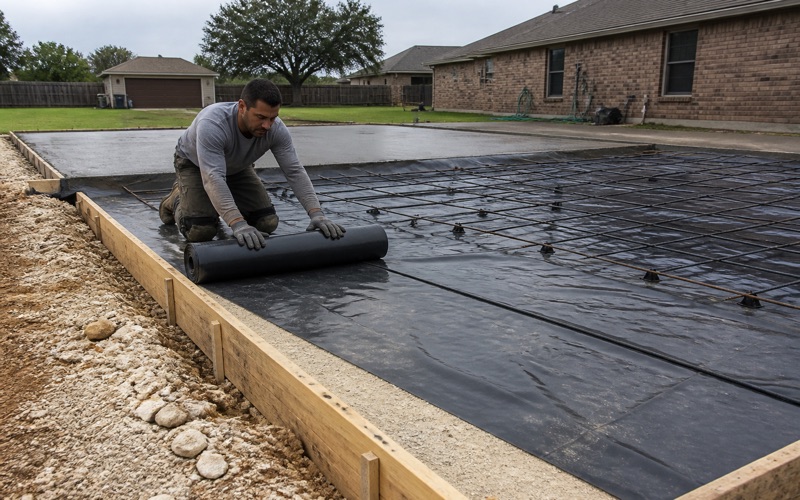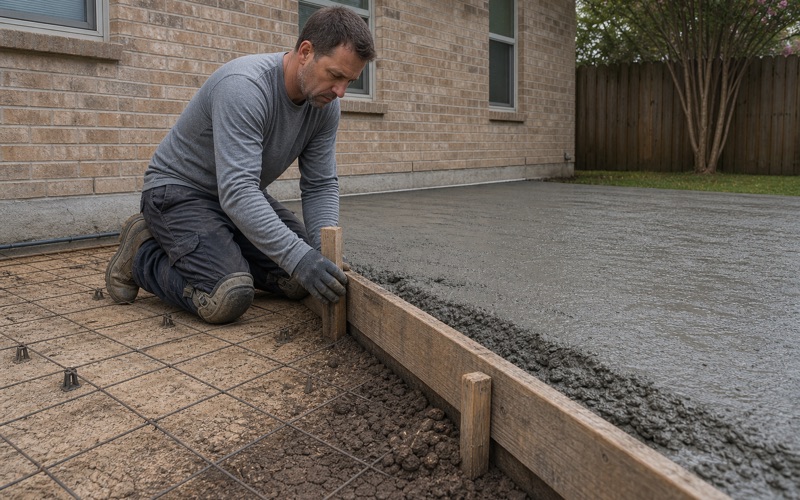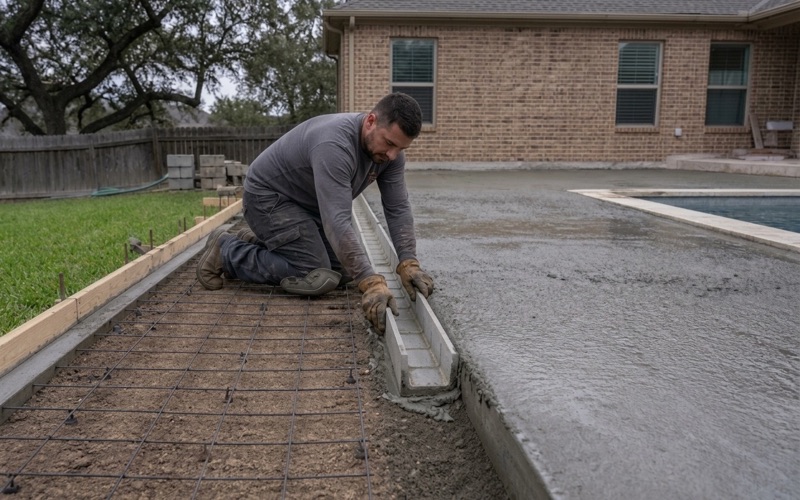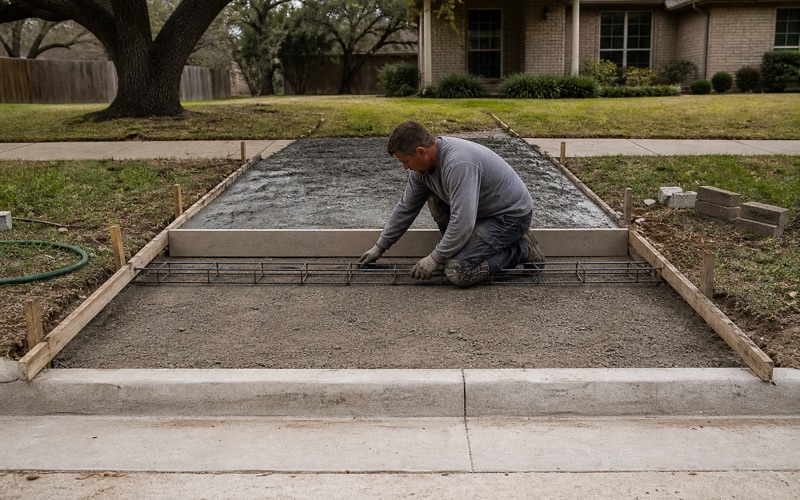
Leander Elite Concrete works as a concrete contractor in Serenada, TX, replacing driveways, walks, patios and slabs on a housing stock that is unusually uniform in age. Almost everything we are asked to look at here was poured within the same two decades, which changes both what we find and what we recommend.
The community’s housing was built in a narrow window. The five-year American Community Survey year-built distribution records no units built before 1970 and none built since 2019, with roughly 89 percent of the stock going in between 1970 and 1989. That is not a gentle skew; it is a community that was built and then stopped.
The consequence for concrete is direct. The original driveways, approaches, walks and patios are all reaching 35 to 55 years of age at once, which is past the point where sealing and patching returns anything on the money spent. What we do here is replacement and honest assessment rather than maintenance.
A Community With No Recent and No Early Construction
What the Age Distribution Actually Shows
The distribution across about 552 housing units puts roughly 265 in the 1980s and roughly 225 in the 1970s, with only about 42 in the 1990s, about 10 in the 2000s and about 10 in the 2010s. Nothing was recorded before 1970 and nothing since 2019.
Those are survey estimates rather than a census of slabs, so we treat them as the shape of the stock rather than as exact counts, and we would not quote a job from them. The shape is the useful part: two decades carry nearly everything, the tails are close to empty, and that pattern holds street by street rather than averaging out across the community.
We mention it at estimates because homeowners often assume their driveway is an outlier. It is almost never an outlier here; it is the same age as the one across the street and the one behind it, and it is failing for the same reasons.
Why Uniform Age Changes the Assessment
When a stock is mixed in age, a failing slab is usually a story about that particular property: a bad pour, a drainage problem, a heavy vehicle. When everything went in within twenty years, the more likely story is simply elapsed service life.
That changes what we look for. Rather than hunting for the one event that damaged a slab, we assess how the whole run has aged, whether the base beneath it is still doing its job, and whether the surface has any remaining life worth preserving.
It also makes comparisons useful in a way they usually are not. What a neighbor’s driveway looks like is genuinely informative here, because it was poured in the same period, on the same kind of ground, under the same weather, and it has had the same number of years to show what that produces.
What the Ground Underneath Is Doing
Everything mapped inside this community is limestone-derived, and the units over the built-up center reach limestone at roughly 89 centimeters, about 35 inches, beneath a subsoil that runs to 70 percent clay with a plasticity index climbing to 48. Elsewhere in the community the rock is far shallower, beginning around 28 centimeters, about 11 inches.
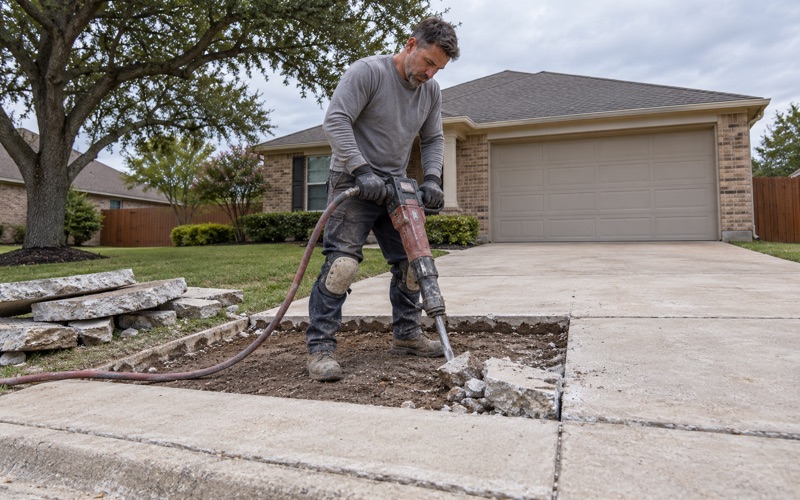
That matters at replacement rather than at repair. Once an old slab comes out, we can see and correct what forty years of settlement, erosion and root activity have done to the base, which is the part of the job a resurfacing can never reach.
Looking for concrete-contractor closer to Wells Branch? See Concrete-Contractor in Wells Branch.
What a Driveway Looks Like at Forty Years
The Failures That Show Up Together
A slab at this age typically shows several things at once: cracks that have widened past the point of closing, panels that have settled relative to one another, surface loss where the top layer has worn or scaled away, and joints that have long since filled with debris and stopped functioning as joints.
Any one of those on its own might be a repair. All of them together on the same run is a slab that has finished its service, and the pattern is consistent enough here that we can usually say so at the first visit.
The tell we rely on most is movement. Panels that rock underfoot have lost the support beneath them, and no surface treatment applied on top restores support that is no longer there, which is why we test panels underfoot before we look at anything on the surface.
When Patching and Sealing Stop Paying
There is a real point at which maintenance stops returning value, and on this stock most original flatwork is past it. Sealing a surface that is losing its top layer buys appearance for a season, and patching a crack over a slab that is moving reopens the same line.
We say that plainly rather than selling the smaller job, even though the smaller job is easier to agree to. A patch on a forty-year-old driveway is generally money spent twice, because the second expenditure is the replacement that was always coming, and the patch neither delays it much nor reduces it.
Where maintenance genuinely does still pay, we say that too, and we are happy to leave a job unsold on that basis. A slab in sound condition, with joints still functioning and no differential movement between panels, is worth cleaning, sealing and leaving alone for several more years.
Judging the Base, Not Just the Surface
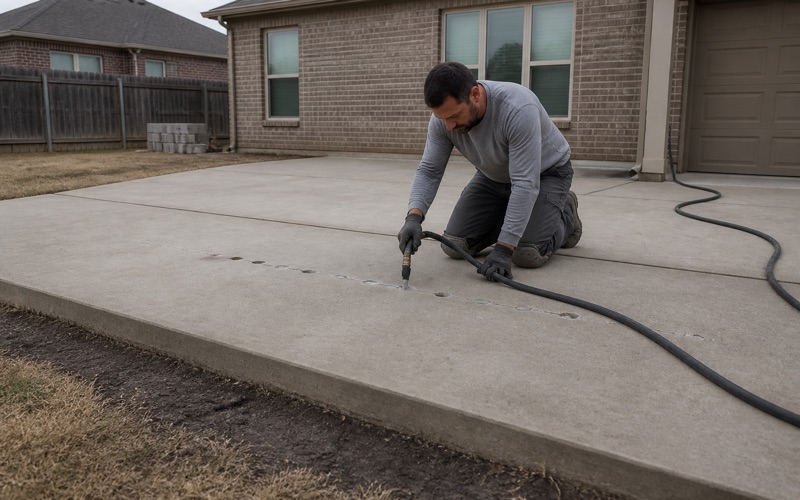
The honest assessment happens below the concrete. We probe for voids, look at how water moves across and under the run, and check whether the panels have moved relative to one another rather than simply cracked.
Old flatwork frequently sits on a base that was adequate when placed and has since been eroded by roof runoff, irrigation or plain time. Replacing concrete without correcting that leaves the new slab starting from the same disadvantage the old one ended with.
Long Private Runs on Acre Lots
What an Acre Lot Does to a Driveway Job
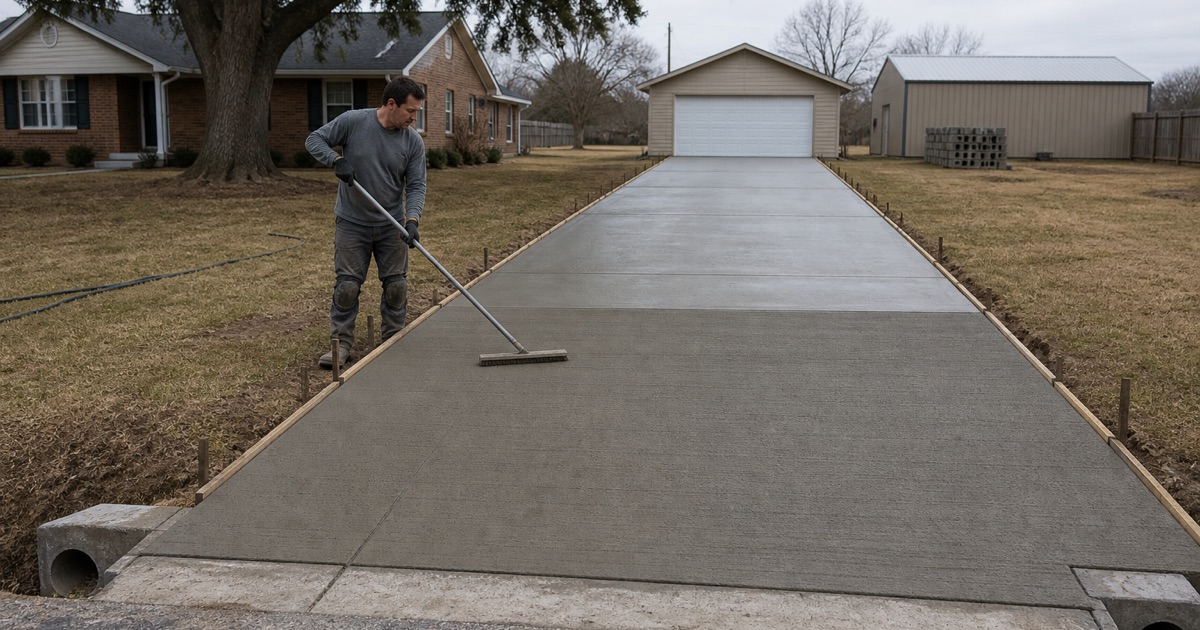
With a median parcel of about 1.04 acres and roughly three quarters of parcels at an acre or more, driveways here are long private runs with deep front setbacks rather than short suburban aprons. That changes the arithmetic of a replacement considerably.
Area is the obvious difference, but the more useful one is that a long run gives options. Not every part of a long driveway ages at the same rate: the section nearest the street takes the turning movements and the heaviest loads, while the section nearest the house often shows drainage damage instead, and the two frequently justify different answers.
Access, Staging and the Advantage of Space
Lots this size usually allow a truck or a skid-steer to reach a back yard without crossing a neighbor’s ground, which removes the constraint that most complicates urban concrete work. Material can be staged on the property and equipment can turn without a road closure.
We use that room deliberately rather than treating it as incidental. It makes phased work practical, keeps the street clear for neighbors, allows spoil and material to sit somewhere sensible, and generally means a lower price than the same square footage would cost on a tight lot with no access.
The corresponding constraint is that long runs are their own drainage structures. A driveway of that length collects and directs a meaningful volume of water, and where it discharges matters to the house, the yard and the road it meets.
Deed Restrictions Recorded Section by Section
Private restrictions here exist section by section, across Serenada East Units 1 through 5, Serenada West and its Sections 2 through 4, and Serenada Country Estates Units 1 and 2, rather than as a single instrument covering the whole community, and no registered mandatory homeowners association was located.
That means restrictions on paving, outbuildings and setbacks are enforced through the title record rather than by an architectural committee with a fee schedule and a submittal form. We check the recorded restrictions for the specific section rather than assuming a community-wide standard.
Practically, it also means the person signing the contract is almost always the person who lives there, since nearly every occupied unit is owner-occupied and detached. There is essentially no management layer between the estimate and the decision.
Replacing in Sections, When the Whole Street Is the Same Age
Phasing a Replacement Over Time
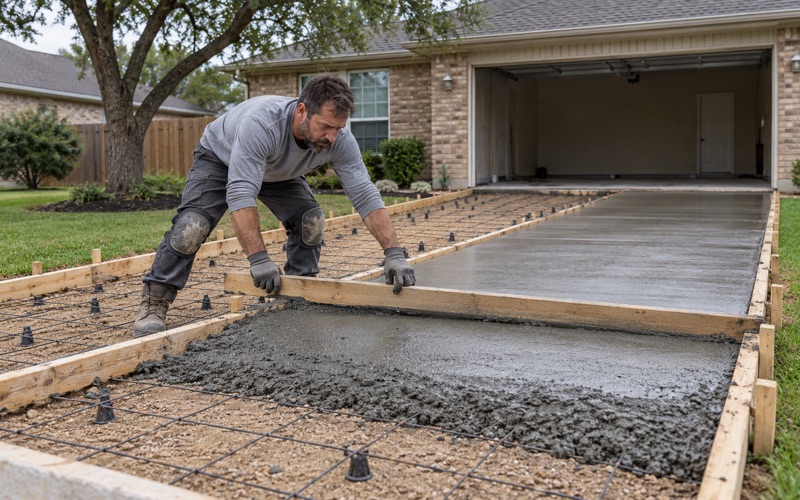
Because these driveways are long, replacement does not have to happen in one operation. We can replace the worst sections first and leave sound panels in place, provided the joints between old and new are properly formed and the base under the new work is corrected.
That is a genuine option rather than a compromise, but it comes with a caveat we state up front: the remaining old sections are the same age as the ones being replaced, so a phased approach spreads cost rather than avoiding it.
Where phasing makes most sense is when one section has failed noticeably ahead of the rest, usually because of drainage or a tree. Where the whole run is uniformly worn, doing it once is generally better value and produces a better result.
Matching New Concrete to Forty-Year-Old Work
New concrete will not match forty-year-old concrete, and we say so before the pour rather than after. Cement source, aggregate, weathering and simple age all differ, and new work lightens further as it cures.
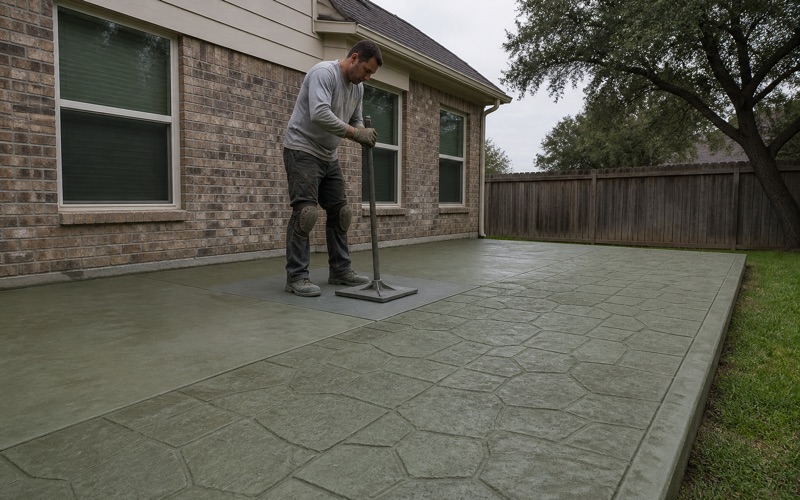
What works better than chasing a match is making the transition deliberate: a formed joint at a panel line, a border, or a change of finish, so the boundary reads as intentional. A near-match that is slightly wrong looks like a mistake in a way that an obvious, clean boundary does not.
Working Where Everything Is the Same Vintage
Serenada is a census designated place in Williamson County whose population was 2,098 at the 2020 census, and those living here have Georgetown addresses. Across a community that size where the flatwork all dates from the same period, the same conversations recur street by street.
We find that useful rather than repetitive. Knowing what this vintage of slab looks like when it is worth saving, and what it looks like when it is finished, is most of what makes the recommendation reliable, and it is why we would rather assess a driveway properly than quote from a photograph.
- 20+ Years in Concrete
- Licensed & Insured
- Free Estimates