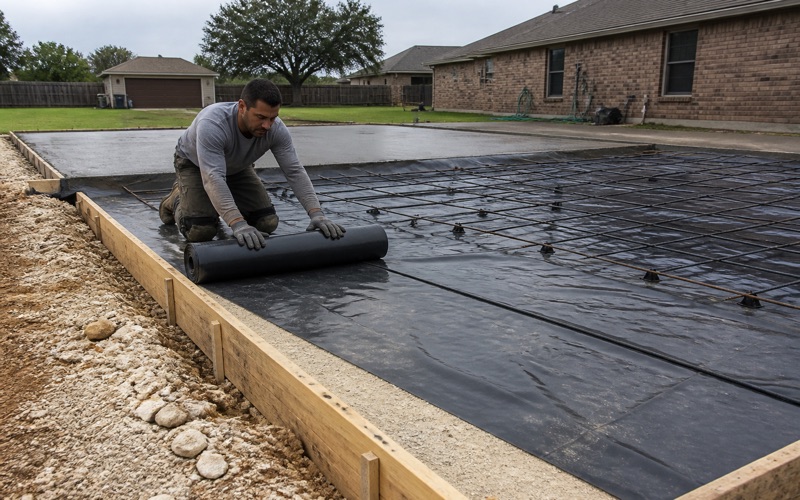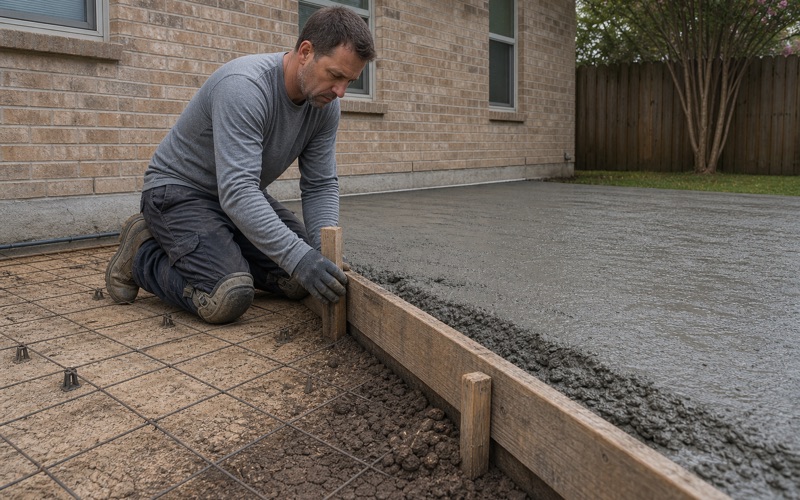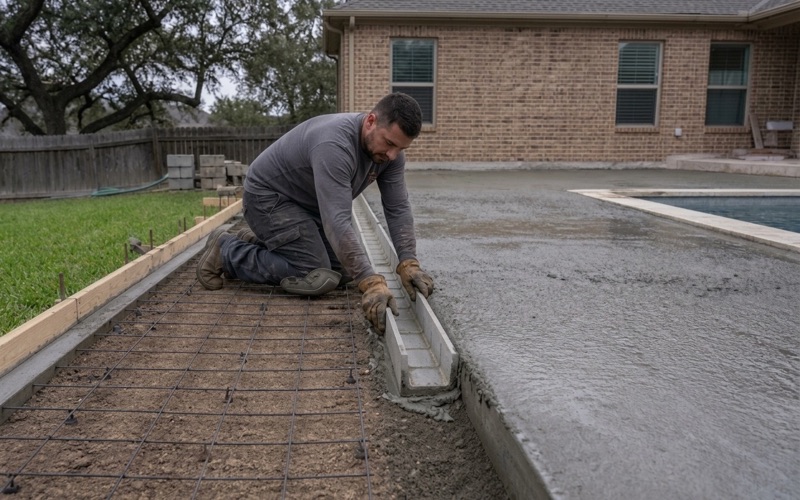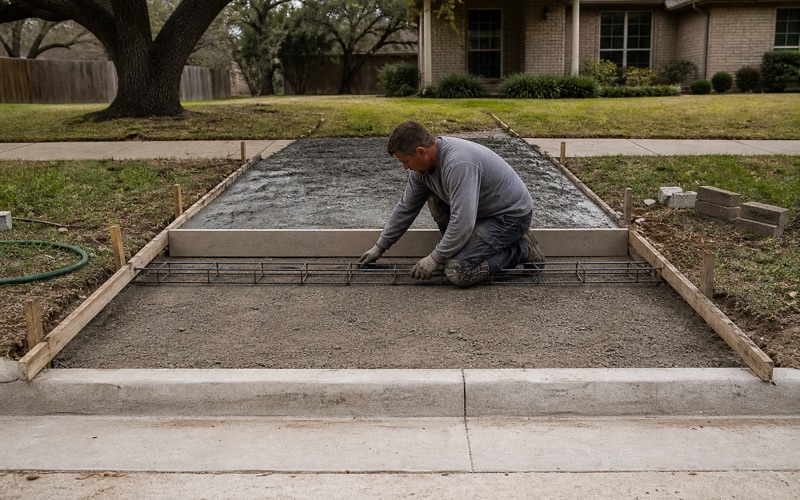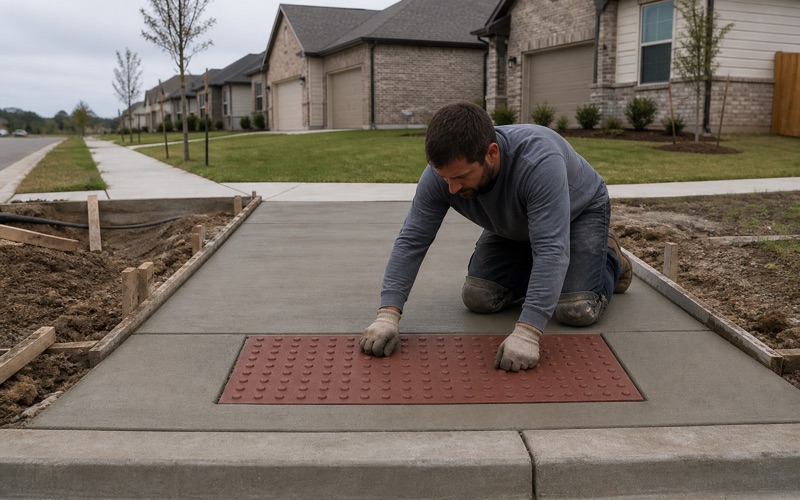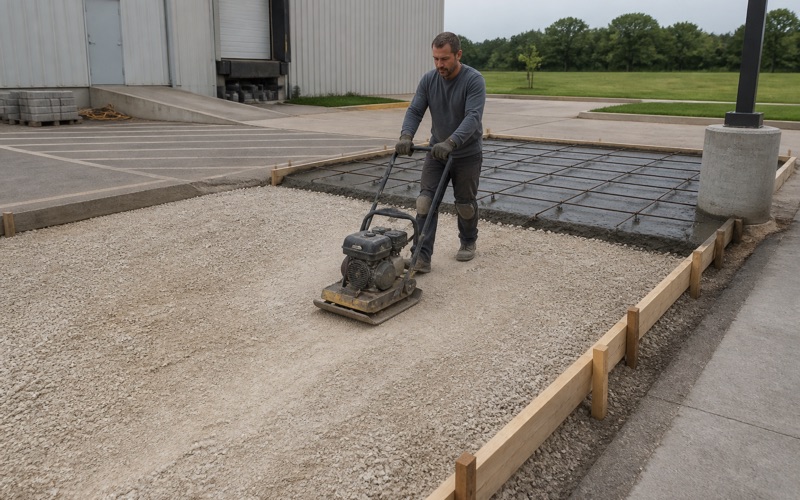
Leander Elite Concrete works as a concrete contractor in Taylor, TX, building pavement, driveways, slabs, walks and approaches with more than 20 years of experience behind the work. The ground here is deep, uniform and highly expansive, and the city’s answer to it is written into every street section it publishes: eight inches of lime treated subgrade before anything else goes on.
Lime treatment is the standard remedy for expansive clay, and this city specifies it carefully rather than assuming it. That care exists because lime is not always the right answer. Where soluble sulfate is present in sufficient quantity, adding lime can produce sulfate-induced heave, and the ground moves more after treatment than it did before.
So the sulfate content is measured before the decision is made. That single test decides whether the standard fix can be used at all, and it is the reason a subgrade specification here starts with a laboratory result rather than with a construction method.
The Test That Decides Whether Lime Is the Right Answer
Why Sulfate Matters
Lime reacts with clay to reduce plasticity and produce a stable working platform, which is exactly what this ground needs. Where soluble sulfate is also present, a different reaction becomes possible, and the resulting expansion can lift a treated subgrade well beyond anything the untreated clay would have done. That is the failure the test exists to prevent. It is not a marginal risk that turns up occasionally; it is a well-understood mechanism, and the reason a specification that would otherwise be routine carries a threshold test in front of it.
Testing Before Designing
Because the result determines whether lime can be used, the test sits ahead of the design rather than alongside it. A pavement section drawn on the assumption of lime treatment is a section that may have to be redrawn.
We treat the sulfate result as an input to the design rather than a confirmation of it, and on any job where subgrade treatment is part of the scope, we want that number before committing to a method. It is far cheaper to know at the design stage than to discover afterward. Where a client is working with an engineer already, the test frequently sits inside work that is being done anyway, which is another reason to raise it early rather than treating it as an additional cost.
What the Ground Actually Is
The ground here is uniform in a way most of this region is not. Point queries across the city returned only two map units: Branyon clay on the downtown grid, the northwest, the southwest and the southeast, and Burleson clay on the northeast. Branyon carries a representative plasticity index of 39 in the plow layer and 43 in the Bkss horizon from 31 to 183 centimeters, at 53 percent clay with linear extensibility of 13 percent and very low permeability. No bedrock restriction is published within the profile, so excavation here is a clay-handling and moisture-control problem rather than anything else.
Looking for concrete-contractor closer to Hornsby Bend? See Hornsby Bend Concrete-Contractor.
Three Sulfate Bands, and What Each Means
Below Three Thousand Parts Per Million
Below 3,000 parts per million the subgrade is compatible with lime treatment, and the standard approach applies without qualification. That is the straightforward case and it covers a great deal of work here. We still specify the treatment properly rather than treating compatibility as the end of the question.
Depth, rate, mixing and the plasticity result afterward all matter, and compatibility only means the method is available. A treatment applied at the wrong rate, mixed shallow or left to dry before compaction will not deliver the plasticity result the specification asks for, and the test that follows is what reveals it.
Between Three Thousand and Eight Thousand
Between 3,000 and 8,000 parts per million the subgrade is generally compatible, but the pavement engineer must consult the city for approval. That middle band is a judgment call taken with the city rather than a decision a contractor makes alone. We plan for that consultation as a step in the program rather than an informal conversation.
It has a lead time, and a project that assumes approval will follow automatically is a project exposed to a schedule it does not control. We would rather build the consultation into the program at the start, where a few weeks is a planning decision, than reach it with a crew already committed.
Above Eight Thousand
Above 8,000 parts per million the subgrade is incompatible with lime treatment. At that point the standard remedy is off the table and an alternative approach to the subgrade has to be designed. We would rather find that out from a test than from a pavement that heaves after it is built.
The result is not common, and when it occurs the alternative has to come from an engineer rather than from a substitution made on site. Reducing the lime rate is not a workaround for an incompatible subgrade; the incompatibility is with the chemistry rather than with the quantity.
Eight Inches of Treated Subgrade, and Two Feet Past the Curb
The Section Every Street Type Starts With
Both the flexible and the rigid minimum pavement sections for every Taylor street type begin with eight inches of lime treated subgrade. That is the same starting point regardless of street classification, which tells you the treatment is aimed at the ground rather than at the traffic.
We build that depth as specified rather than reducing it on lighter sections. The purpose of the layer is to control the clay beneath it, and the clay does not become less active because the street above it carries fewer vehicles. The section above the treated layer varies by classification, with local streets taking 3 inches of Type B dense-graded hot-mix asphalt and 6 inches of concrete in the rigid case and collectors taking 4 inches and 7 inches, but the eight inches beneath does not.
Two Feet Past the Back of Curb
The treated subgrade extends two feet past the back of curb line, which is a detail that is easy to shorten and expensive to get wrong. The edge of a pavement is where moisture enters and leaves most readily, so the untreated clay just outside the section is the most active material near the structure. We carry the treatment the full distance rather than stopping at the curb.
It is a small quantity of extra material and it protects exactly the zone where seasonal movement does most of its work on an edge. Cracking that starts at a pavement edge and works inward is the pattern that detail is there to prevent.
Getting the Treatment Itself Right
The specification is detailed rather than gestural: treatment depth of eight inches minimum, a conditioning mix that must bring the plasticity index down to a maximum of 20 after treatment, and a stabilizing mix that must reach a minimum 28-day unconfined compressive strength of 100 psi and a minimum pH of 12.3.
Lime solids are typically specified at 5 percent by weight for non-lime-reactive materials with a pH of 7.0 or less and 7 percent for lime-reactive materials with a pH above 7.0, applied in slurry form unless the city approves otherwise. We apply it that way and verify the post-treatment plasticity rather than assuming the rate delivered the result. Slurry application is also better for mixing uniformity than dry spreading, which matters on a material whose whole purpose is to react evenly through a depth.
Geogrid, and Why It Stopped Being Optional
Required Rather Than Recommended
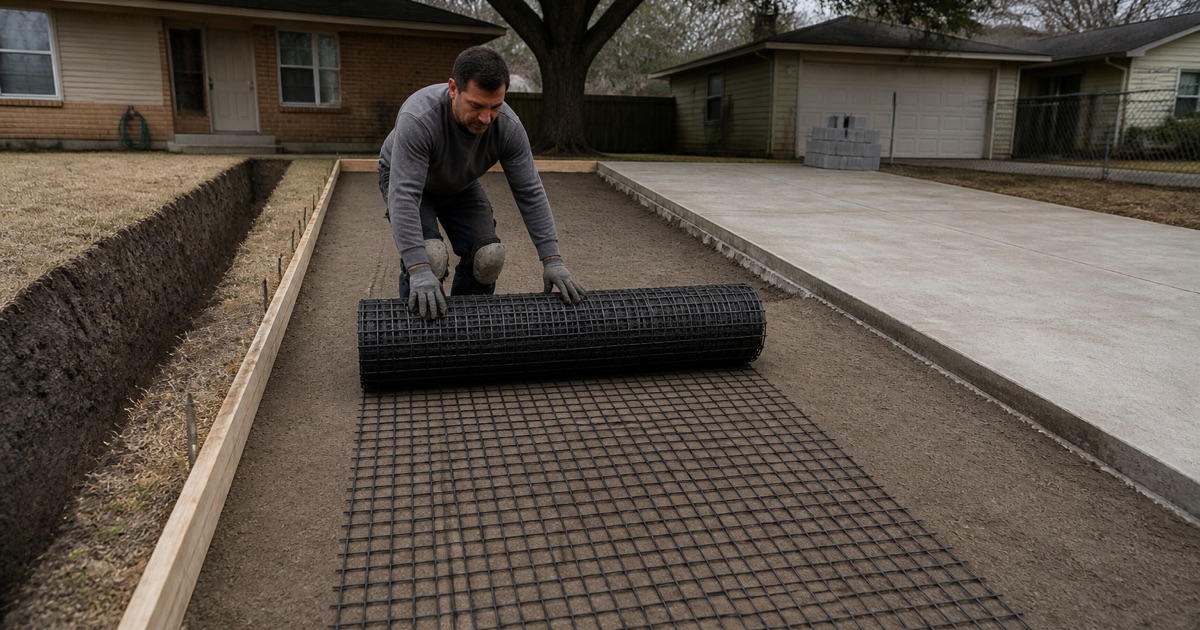
Triaxial geogrid is required rather than optional in flexible sections. The manual states that the city’s experience has shown geogrids effective at controlling environmental cracking, names a recommended type, and requires that it be specified in the plans to be pinned during installation.
That phrasing is worth noticing. A requirement grounded in a city’s own experience is a different kind of rule from one adopted by reference, and it usually means somebody watched pavements fail without it. Environmental cracking on ground like this is not a construction defect in the usual sense: it comes from the subgrade moving with moisture rather than from anything the pavement crew did, which is why the remedy sits inside the section rather than in workmanship.
Pinning as Part of the Specification
The requirement that geogrid be pinned during installation is the part most often treated casually. Geogrid that shifts during placement does not do what it was specified to do, and once material is on top of it there is no way to tell whether it moved. We pin as specified and inspect before covering.
It is a small operation that determines whether an expensive material performs or simply sits in the section as a line item. Because the plans have to specify the pinning, it is also a checkable requirement rather than a matter of practice, and we would rather be checked on it than not.
Density Control Keyed to the Ground
Field density control here is keyed to plasticity index rather than applied as one figure, which is consistent with everything else about the way this city specifies for its ground. The target follows what the material tests at rather than what a general table suggests. Taylor is a city in Williamson County whose population at the 2020 census was 16,267, up from 15,191 in 2010. On ground this uniform and this active, the specifications are unusually prescriptive, and the useful posture for a contractor is to follow them closely rather than to substitute experience from a place where the clay behaves differently.
- 20+ Years in Concrete
- Licensed & Insured
- Free Estimates